Pictish Mystic · Lore · Red Branch
The Deaths of Ailill and Conall Cernach
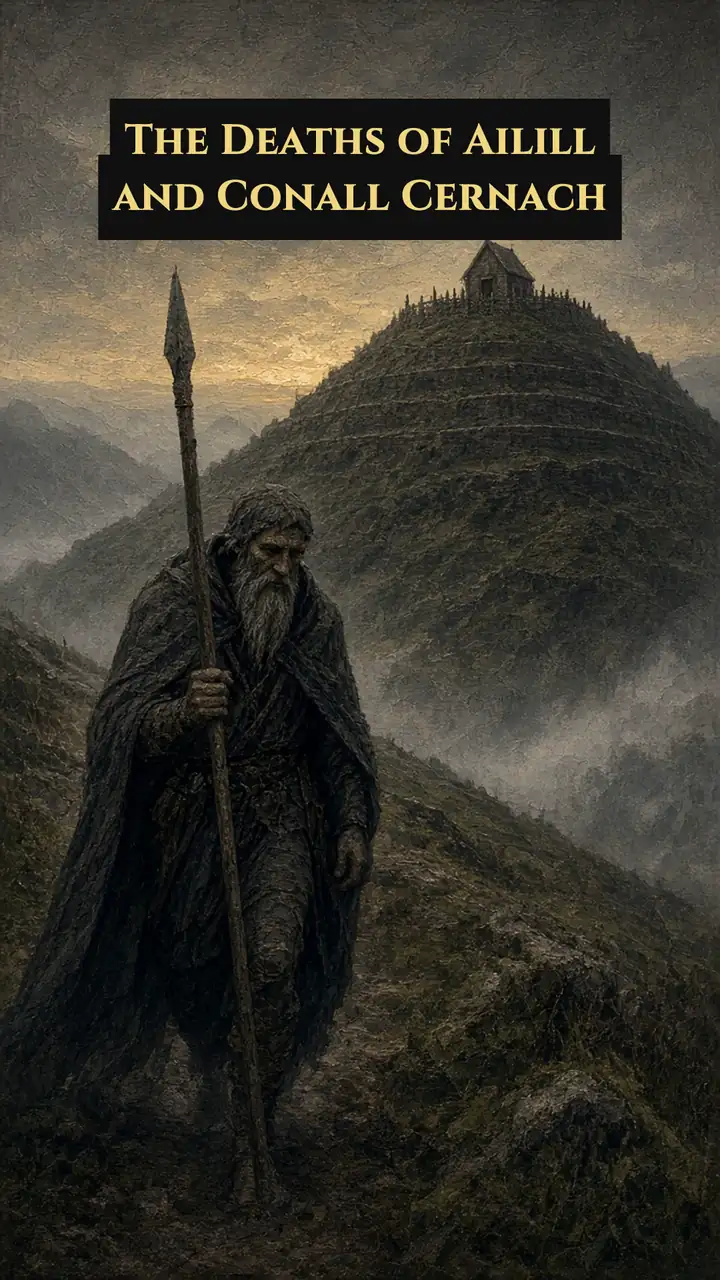
In the Ulster Cycle, Conall Cernach, Conall the Victorious, son of Amargen, was called the best warrior in Ireland, and he was in deadly feud with Connacht, for the men of Connacht had killed his brothers, and there was hardly a man among them whose son, brother or father Conall had not slain. Among the dead were three sons of Ailill and Medb, and the seven sons of Mágu, Cet among them. This is legend from medieval manuscripts, told here as myth, not history.
After his foster-brothers Conchobar and Cú Chulainn were slain, weakness and sorrow fell on Conall the Victorious, until there was no strength in his feet. He asked himself which household could keep and feed him. “Ailill and Medb, truly,” he said, though his enmity towards them was great. So he went, alone, to his greatest enemies at Rath Cruachan. Ailill bade him welcome, and Medb had a house made for him on the rampart of the rath. They fed him for a full year, and every day he would tell the men of Connacht how he had killed their sons, their brothers and their fathers, while they brought him their spears to set.
Ailill, the old text says, was a man without jealousy, but he kept meetings with other women, and Medb was jealous of it. So she took Conall into her household as a watch on him. Early one May-day morning Ailill met a woman by the side of the fort while Conall was setting spears on the rath. Medb went out, and she saw the hazel-bush beside the couple moving. “Conall the Victorious has been thy name till to-day,” she said. “Henceforth thy name shall be Conall the Wicked Wretch.” “Truly, here is a revenge for Fergus!” said Conall, and he cast his spear, and it passed through Ailill.
“Conall did it,” said Ailill. “Take thyself away from my face before I die. For after my death the men of Connaught will kill thee.” Conall asked only to reach his chariot in front of the fort. “I shall not die till then,” said Ailill. Conall went into his chariot, and Ailill died. The men of Connacht hurled their spears after him, and he slew a great number of them.
But Conall had a geis never to go into a ford unless its water was strained after him. Miners were washing ore in the river above, and the troubled water reached him and held him fast. There he fell, and the three Red-wolves of Martine, of Ailill's household, cut off his head, in revenge for Cú Roí, whose head the men of Ulster had carried north. Medb came up in the pursuit and spoke over him: “It is the face of a hero, the head of Conall, son of Amargen.” The tale ends with a prophecy that if the head is ever taken back to Ulster and its men drink milk from it, their old strength will come to them again.
These are legends from medieval manuscripts, not recorded history.
Story told by John. Source: Goire Conaill Chernaig i Crúachain ocus Aided Ailella ocus Conaill Chernaig, translated by Kuno Meyer, Zeitschrift für celtische Philologie 1 (1897), pp. 106–109, on CELT, the Corpus of Electronic Texts (University College Cork).
Source note: the translation used here is published by CELT (University College Cork) and marked by CELT for academic research and teaching use only. This article retells the tale in our own words with brief quotations and full citation, and is provided for entertainment purposes only.
Read in the Pictish Mystic app · Draw a free Pictish rune reading