Pictish Mystic · Lore · Picts
The Norrie's Law Hoard: Pictish Silver from Largo
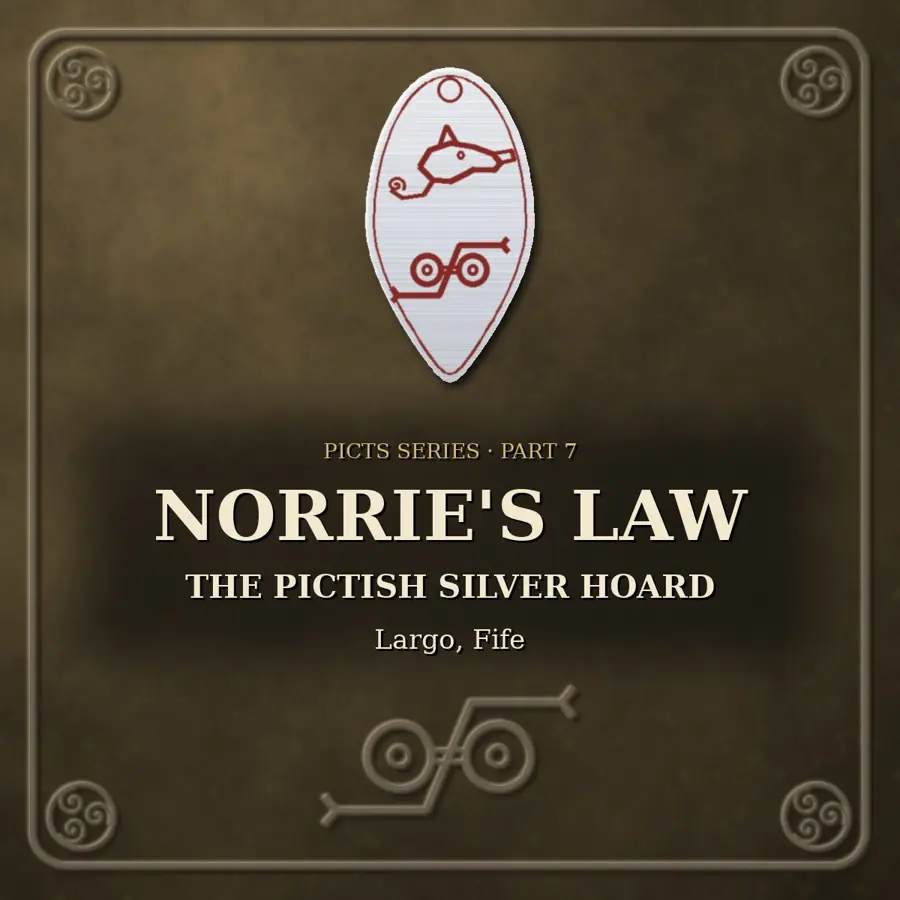
Around 1819, at the foot of an ancient cairn in the hills above Largo Bay in Fife, someone digging for sand struck a mass of silver. It may have been the largest Pictish silver hoard ever found, and almost all of it went into the melting pot. What survives, a handful of pins, brooches, rings and fragments, includes one of only a few objects anywhere that carry a Pictish symbol in silver. Two centuries later, scientists at National Museums Scotland found that part of what was saved was not what it seemed. This is part 7 of our Picts series. As always, history and archaeology, legend and scholarly debate are kept apart, and the sources are named.
History (The Cairn on the Hill)
Norrie's Law is a large prehistoric cairn on the Largo estate, about three miles inland from the north shore of Largo Bay, near the old boundary between the parishes of Largo and Ceres. It sits on a natural ridge of sand and gravel, and Joseph Anderson described it as standing on the highest point of that ridge, "commanding an extensive view". When it was opened up in the 19th century, three stone cists were found inside; one held a small urn and another burnt bones (John Stuart, 1867). It is a monument of the Bronze Age or earlier, many centuries older than the Picts, and it is now a scheduled monument protected by Historic Environment Scotland. The Fife place-name survey records that part of a Pictish symbol stone was also found there in the 19th century.
History (A Hoard Sold for Scrap)
In or about 1819 a labourer, or perhaps more than one, was digging sand at the base of the mound and uncovered a great quantity of silver. Later writers spoke of a "stone coffin", but Anderson thought that was "clearly an inference", and no bones were reported. Who found it is unknown. The silver was quietly passed to a travelling hawker or pedlar, identified only as Forbes in an unpublished letter from John Stuart, and sold off as scrap metal. A jeweller in Cupar, Robert Robertson, bought several lots, a larger share went to a buyer around Edinburgh, and some pieces were simply given away locally: the historian John Leighton wrote in 1840 that a farmer in Ceres parish had made heads for walking staffs from silver "scales". In 1851 Daniel Wilson wrote that the man who had taken the hoard still lived "in good circumstances" at Pitlessie in Fife, and declined all communication on the subject.
How much was lost? George Buist, who later investigated the find, estimated "not much under 400 ounces" of silver, about 12.5 kg. What survives today weighs around 750 grams, roughly one-seventeenth of that. Under Scots law the find should have gone to the Crown as treasure trove, which helps explain the secrecy.
History (The Silver Armour of Norrie's Law)
Pieces left behind or overlooked by the finder were picked up by the tenant farmer's brother-in-law and another man and handed to the landowner, General James Durham of Largo. Another account, from Robertson himself, says Durham had men search the sand-pit. For twenty years the remnant stayed quietly at Largo House.
It came to light in 1839, when George Buist of Cupar (later of Dundee and Bombay) read a report to the Fifeshire Literary and Antiquarian Society, dated "Cupar Museum, Nov. 1, 1839", with lithograph plates. Buist relied heavily on Robertson's memories of what he had melted down: a shield with "the figure of a man on horseback", a helmet, a sword handle, eight "bodkins" or pins, a great many "scales or plates" with hooks, and coins said to carry symbols like those on the plaques. From this he pictured a warrior buried in a suit of silver armour. James Graham-Campbell has suggested that the "shield" may really have been a Late Roman silver dish, and the "scales" pieces of cut-up Roman plate.
General Durham died in February 1840. His niece, Mrs Dundas Durham, inherited Largo in 1842 and allowed the hoard to be shown: to the Archaeological Institute in 1849, at the Great Industrial Exhibition in Dublin in 1853 and in Edinburgh in 1856, when it was listed as 153 objects and fragments. She gave most of it to the museum of the Society of Antiquaries of Scotland in 1864, and her son Robert Dundas of Arniston handed over the rest in 1883. It is now in the National Museum of Scotland in Edinburgh.
History (What Survives)
National Museums Scotland counts about 170 pieces today, weighing less than a kilogram. They include:
- A leaf-shaped silver plaque, 9.1 cm long, engraved with two Pictish symbols: the double disc and Z-rod, and a beast's head with a long curling lappet or flipper. Both symbols were once filled with red enamel.
- Large silver hand-pins about 17 cm long, with a hand-like head of "fingers" set above a curved plate. One original has a small cross on its central finger, set against red enamel.
- Two penannular brooches with unusual twisted, spiralled hoops, a form otherwise known only from the Gaulcross hoard in Banffshire.
- A spiral finger-ring, a small disc with a central knob (perhaps a lid), a thick sheet with hollow spiral bosses, arm-band fragments, a chain and rods, strips with dotted ornament, and a thin plate with a raised border.
- Roman silver: a crushed fragment of an inscribed 4th-century spoon. Two 4th-century Roman silver coins, of the emperors Constantius II and Valens, were recorded in the 19th century but are now lost.
Much of the rest is hacksilver: chopped-up scrap kept as bullion. Silver was not mined in Scotland at this time. Almost all of it came from the Roman world, as coin and as cut-up tableware paid out to peoples beyond the frontier, and it was melted and reworked again and again for centuries.
History (The Victorian Copies)
In 1839 Buist had Robertson, the same Cupar jeweller, make pewter copies of some of the surviving pieces for the scientific societies of Cupar and St Andrews; they are now in St Andrews Museum. Soon afterwards Buist announced that, thanks to his inquiry, a second symbol plaque and a second hand-pin had been "recovered from hands from which they might... have passed into the crucible of the silversmith". For over 150 years the hoard was described as having two symbol plaques and two matching pins.
From 2008 the NMS Glenmorangie Research Project re-examined everything. Martin Goldberg and Alice Blackwell (2013) showed that the second plaque and pin are unworn casts which reproduce the wear and damage of the originals, and analysis by Dr Susanna Kirk found that they are made of highly refined silver of a kind only available in modern times. They are silver copies made around 1839. A small detail points to their maker: a floriated Z-rod engraved on the back of the copied pin also appears on Robertson's pewter copy, but not on the original pin, and it faintly resembles the fleur-de-lys of his own maker's mark. The authors suggest Robertson may have made them out of guilt, or to support his story that the hoard held more plaques and pins, though his motive cannot be proved. Sally Foster, Alice Blackwell and Martin Goldberg developed the story in the Journal of Victorian Culture (2014). As NMS puts it, the number of Pictish symbol-bearing objects in the hoard fell from three to one.
Legend and Tradition (Tammie Norrie and the Gold of Largo Law)
Robert Chambers took down a story from tradition in 1825. A gold mine was believed to lie under Largo Law, the high hill above the village; the sheep that grazed there sometimes came home with their wool tinged yellow, which was taken as a sign of the gold beneath. A ghost haunted the hill, and a shepherd resolved to ask it where the gold lay. The ghost would tell him only on one condition:
"If Auchindownie cock disna craw,
And Balmain horn disna blaw,
I'll tell ye where the gowd mine is in Largo Law."
The shepherd had every cock at Auchindownie killed. But on the appointed night Tammie Norrie, the cowherd at Balmain, blew his horn as usual, and the ghost cried:
"Woe to the man that blew the horn,
For out of the spot he shall ne'er be borne."
Norrie fell dead where he stood. His body could not be moved, so a cairn of stones was raised over it: Norrie's Law. Local people thought the place uncanny. Walter Wood (1887) recorded that tradition pointed to it as the grave of a warrior called Tammy Norrie, and that it was also called Norroway's Law.
In the 19th century the popular version became the warrior laid in his silver armour, as Buist had pictured. Anderson said in his 1880 Rhind lectures that this "rests upon no basis of evidence, or even probability".
Scholarly Debate (Where Does the Name Come From?)
Simon Taylor's Fife place-name survey treats Norrie as a personal or family name (it can be a pet form of Norman), noting the field-names Norriesknow and Norrieswell near Carskerdo in 1813. The "Norroway's Law" form, with its hint of the Norse, is probably an antiquarian invention. Either way, the name is far later than the hoard.
Scholarly Debate (Burial, Treasure or Offering?)
Buist imagined a burial, and Rosemary Cramp (1989) still saw the hoard as possibly the grave goods of a Pictish warlord. Graham-Campbell (1991) noted that no body was ever found and that the silver lay at the foot of the cairn, not clearly inside it. He read it as a single hoard of ornaments and scrap silver, perhaps buried to keep native wealth out of the hands of new Northumbrian overlords. The symbol plaques themselves are another puzzle: they have no obvious practical use, and Albert Way asked as early as 1849, "May they not have been destined for some mystic or magical purpose?" Graham-Campbell thought a votive or ceremonial role possible, pointing to the lost bronze crescent from the Laws of Monifieth, which carries symbols on both sides. More recently Gordon Noble and colleagues (2016) pointed out that both Norrie's Law and Gaulcross were buried beside far older monuments on high ground with views to the sea, and suggested a link with ancestors, the gods, or claims to land.
Scholarly Debate (How Old Is It?)
Dates proposed for the hoard span three centuries. Robert Stevenson (1955) put the plaques around 700 or later. Charles Thomas (1961) suggested the 6th century, and Elizabeth Fowler and Stuart Piggott about 600. Lloyd Laing compared the hoard to the Roman silver of Traprain Law and dated it to the 4th or 5th century. Isabel Henderson (1989) likened the beast head to the dogs in the Lindisfarne Gospels, which favoured a later date. Graham-Campbell argued for the second half of the 7th century, perhaps around the Northumbrian conquest of Fife in the 650s, and pointed out that Traprain (over 20 kg of ornate Roman tableware, with no native pieces) was a very different kind of hoard.
The discovery of the copies changed the argument. The cross on one pin had been used to date it, and the copied pin could not count as separate evidence. Noble and colleagues (2016) read the beast not as a dog but as a sea or water creature with flippers, and found its best match on a symbol stone at Rhynie in Aberdeenshire, which pairs the beast with a double disc and Z-rod, at a site dated to the 5th and 6th centuries. Many now favour an earlier date: National Museums Scotland gives about 500 to 600 AD, and the 2017 exhibition put the burial in the 5th or 6th century. There is even a suggestion that the plaque was once set into a composite helmet.
Scholarly Debate (A Pictish Treasure)
Whatever its date, Norrie's Law is one of only two Pictish hacksilver hoards known, with Gaulcross, and in surviving pieces it is the largest early medieval silver hoard from Scotland. It shows people in Fife turning old Roman silver into ornaments of their own, marked with the same symbols they carved on stone: the double disc and Z-rod and the beast appear together again on the Monifieth crescent and on the Rhynie stone, and Pictish symbols are carved in the Wemyss caves on the Fife coast. The Picts of Fife carried the old British name of the Pretani (Priteni), and on this small leaf of silver their symbols have survived well over a thousand years, a hasty sale and a Victorian copyist.
Sources
Archaeological reports and records:
- James Graham-Campbell, Norrie's Law, Fife: on the nature and dating of the silver hoard, Proceedings of the Society of Antiquaries of Scotland 121 (1991).
- Joseph Anderson, Notice of the gold ornaments found at Lower Largo and of the silver ornaments found at Norrie's Law, PSAS 18 (1884); and his Rhind lectures, Scotland in Early Christian Times, 2nd series (1881).
- Martin Goldberg and Alice Blackwell, The different histories of the Norrie's Law hoard, in J. Hawkes (ed.), Making Histories: Proceedings of the Sixth International Conference on Insular Art, York 2011 (2013).
- Sally Foster, Alice Blackwell and Martin Goldberg, The legacy of nineteenth-century replicas for object cultural biographies: lessons in duplication from 1830s Fife, Journal of Victorian Culture 19 (2014).
- Gordon Noble, Martin Goldberg, Alistair McPherson and Oskar Sveinbjarnarson, (Re)discovering the Gaulcross hoard, Antiquity 90 (2016).
- Alice Blackwell, Martin Goldberg and Fraser Hunter, Scotland's Early Silver: Transforming Roman Pay-offs to Pictish Treasures (National Museums Scotland, 2017), and the NMS exhibition of the same name (2017 to 2018).
- National Museums Scotland, Norrie's Law hoard (collection story); Current Archaeology review of Scotland's Early Silver (2017).
- Historic Environment Scotland, Norrie's Law cairn, scheduled monument SM2460.
Texts and scholarship:
- George Buist, Report to the Fifeshire Literary and Antiquarian Society on the Silver Armour of Norrie's Law (Cupar, 1839); John Leighton, History of the County of Fife (1840).
- Daniel Wilson, The Archaeology and Prehistoric Annals of Scotland (1851); John Stuart, Sculptured Stones of Scotland, vol. 2 (1867); Albert Way in the Archaeological Journal (1849).
- James Graham-Campbell, Pictish Silver: Status and Symbol (H. M. Chadwick Memorial Lecture, Cambridge, 2003).
- Robert Chambers, Popular Rhymes of Scotland (tradition recorded 1825); Walter Wood, The East Neuk of Fife (1887).
- Simon Taylor with Gilbert Márkus, The Place-Names of Fife (Norrie's Law entry, Fife Place-name Data, University of Glasgow).
History, legend and scholarly debate are marked separately in the headings above.
First shared on X @dalriada36963.
Read in the Pictish Mystic app · Draw a free Pictish rune reading