Pictish Mystic · Lore · Fomorians
Cethlenn – Fomorian Queen, Seer and the Woman Who Wounded the Dagda
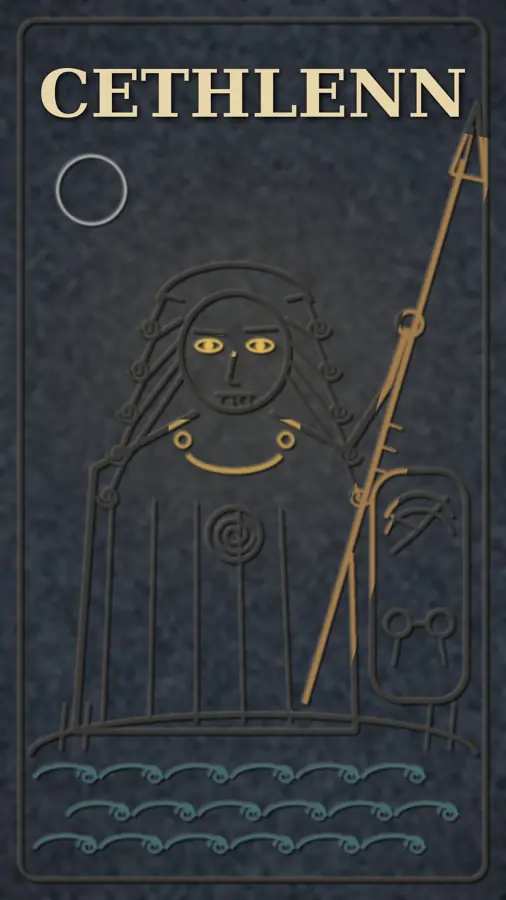
Yesterday: Tethra. Today the one Fomorian woman whose spear changed the story. Legend from Lebor Gabála Érenn (Macalister, on Mary Jones's site), the Annals of the Four Masters and Keating (CELT), the Annals of Clonmacnoise and Oidheadh Chloinne Tuireann. Not history. Told from their side.
The Name
Cethlenn, also Ceithlenn, Ceithlionn, Caitlín. Joyce gives the sound as "Kehlen" and the old Latin-style form Kethlenda. Her nickname in the later tales is Ceithlionn chaisfhiaclach, "of the twisted teeth" (cas, twisted + fiacail, tooth). Joyce made it "of the Crooked Teeth".
The Wound (the oldest layer)
Flann Mainistrech's poem in Lebor Gabála says: "The Dagda died of a dart of gore in the Brug, it is no falsehood, wherewith the woman Cethlenn gave him mortal hurt, in the great battle of Mag Tuired." Keating calls it "the bloody missiles of a cast which Ceithleann flung at him". Eochu Ollathair, the great father of the Tuatha Dé, brought down by her hand.
A Slow Death
The Four Masters put the battle at Age of the World 3330 and the Dagda's death at 3450: he reigned 80 years, then died at the Brug "of the venom of the wound which Cethlenn inflicted upon him". That is 120 years of poison. Odd detail: the same entry says the first battle of Mag Tuired, while Lebor Gabála says the great one. Keating gives him 70 years, not 80. The Brug is usually taken as Brú na Bóinne, the Newgrange country.
Balor's Queen (later tradition)
The early texts never call her Balor's wife. Later tellings do. In Oidheadh Chloinne Tuireann the stewards flee to Lochlann with news of a shining youth. Balor asks who he is. "I know," says Ceithlionn, "that that person is a daughter's son of yours and mine, and it is a sign and an omen to us, that when that person would come into Eire, that never again would we have power in Eire" (O'Duffy). She sits in the war council with Balor and his twelve "white-mouthed" sons.
The Seer
So she is more than a warrior. She names Lugh as her own grandson, through Ethniu, and foretells her people's fall. From their side, that is a hard gift: a grandmother who knows the child is coming for them.
The Rowan Tree Tale
In the Fenian tale of the Fairy Palace of the Quicken Trees, Colga, king of Lochlann, remembers his forefathers who fell in Erin: "Balor of the Mighty Blows; his son Bres also; and his queen, Kethlenda of the Crooked Teeth." So Lochlann kept her as an ancestor.
Enniskillen, Ulster
Enniskillen in Fermanagh is Inis Ceithleann, Cethlenn's island. Joyce (1869) says the Annals of Clonmacnoise name the town from her. But read the Clonmacnoise text itself (Mageoghagan's 1627 English) and it says: "After Breasse succeeded Loway Keyhleann (of whome Iniskihlean tooke the name)". Loway is Lugh. So the annal gives her name to her grandson. Local lore adds that she was wounded and swam the Erne but never reached the far bank. 19th-century writers don't mention the swim, so that part is later folklore.
What Scholars Say
She is missing from Cath Maige Tuired itself and from Stokes's list of Fomorians. Énrí Ó Muirgheasa suggested the Balor legend may once have belonged to this Erne and Breifne country, between Ulster and Connacht, rather than Tory. A theory, not proof.
From Their Side
A queen, a seer, the one who struck the Dagda. A whole town still carries her name.
These are legends from medieval manuscripts, not recorded history.
First shared on TikTok @johnshaw333.
Read in the Pictish Mystic app · Draw a free Pictish rune reading