Pictish Mystic · Lore · Fomorians
Cichol – the Fomorian Who Fought the First Battle of Ireland
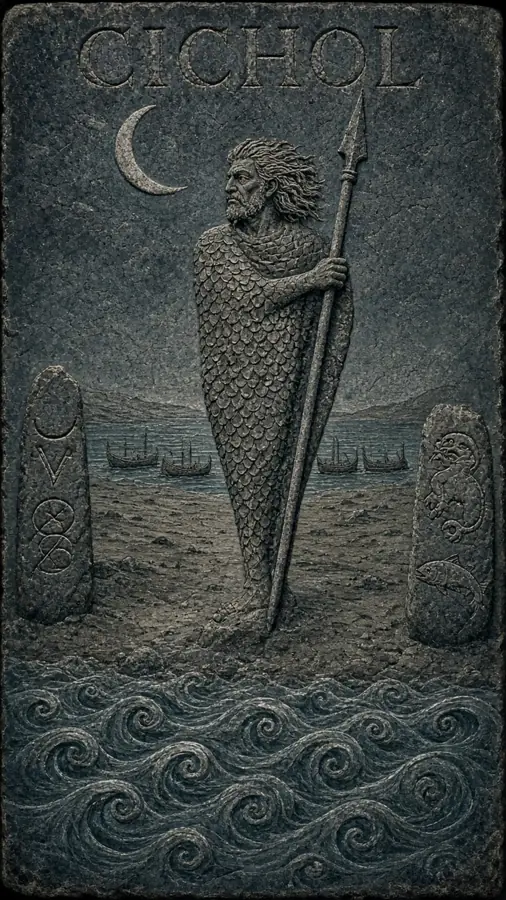
Last time: Octriallach, who buried the well of healing. Today we go right back to the start, to the first battle ever told in Ireland. Legend from Lebor Gabála Érenn (Macalister, on Mary Jones's site) and, on CELT, the Annals of the Four Masters and Keating's History of Ireland. Not history. Told from their side.
The Name
Every text spells him differently. Lebor Gabála: "Cichol clapperlag of the Fomoraig". The Four Masters: "Cical Grigenchosach, son of Goll, son of Garbh, of the Fomorians". Keating: "Cíocal, son of Nel, son of Garbh, son of Ughmhóir, from Sliabh Ughmhóir". Keating even names his mother, Lot Luaimhneach.
Here before Partholón
Partholón is called the first to take Ireland after the Flood. But Keating says "some of our authors reckon another occupation of Ireland before Partholón": Cíocal's. His people lived "two hundred years" there "on fish and fowl" until Partholón came. Seen from their side, they were not invaders. They were the ones already living on the shore.
Six Ships
Keating says Cíocal "took harbour in Ireland" at Innbhear Domhnann: "six ships their number; fifty men and fifty women the complement of each ship." Men and women together. A people, not a raiding party.
The First Battle of Ireland
Lebor Gabála: "the first battle of Ireland, which Partholon won in Slemna of Mag Itha against Cichol". The Four Masters put it in the Age of the World 2530, ten years after Partholón came, and say Cical came "and his mother, ... eight hundred in number". The Fomorians "were all slain. This is called the battle of Magh Ithe." Keating: "in which Cíocal fell".
One Arm, One Leg
Lebor Gabála: "Men with single arms and single legs they were, who joined the battle with him." Keating's poem calls him "Ciocal the stunted, (of withered feet)". This is how the winners' books drew them: strange, broken, not quite human.
The Texts Disagree
His father is Goll in one book and Nel in another. His host is eight hundred, or "three hundred men", or six ships of a hundred. Keating's poem says they were "scattered after that, being cut off in a week". Legend, not one fixed record.
The Victor's Shadow
Keating also says Partholón had fled to Ireland after killing his father and mother, and that God sent a plague on his people: "nine thousand of them were slain during one week". The man who beat the Fomorians was no clean hero either.
A Note on Sources
Every quote here comes from CELT or Mary Jones's site, listed below. The texts do not agree on Cichol's father, the size of his host, or what his by-names mean, so we give each version as written and do not guess. Anything else you may have heard about him is not in the CELT or Mary Jones texts used here, so we leave it out.
From Their Side
Scholars often read the Fomorians as older powers of chaos and the sea. That is interpretation, not text. What the texts do say is that Cichol's people were there first, came with their women, lived off the land and sea, and fell in Ireland's first battle.
These are legends from medieval manuscripts, not recorded history.
Sources
- Lebor Gabála Érenn, part 2: Partholón, tr. R. A. S. Macalister (Mary Jones)
- Annala Rioghachta Eireann: Annals of the Four Masters, vol. 1, tr. John O'Donovan (CELT)
- Foras Feasa ar Éirinn: The History of Ireland by Geoffrey Keating, tr. David Comyn and P. S. Dinneen (CELT)
First shared on TikTok @johnshaw333.
Read in the Pictish Mystic app · Draw a free Pictish rune reading