Pictish Mystic · Lore · Fomorians
Conand – the Fomorian Lord of the Tower on Tory
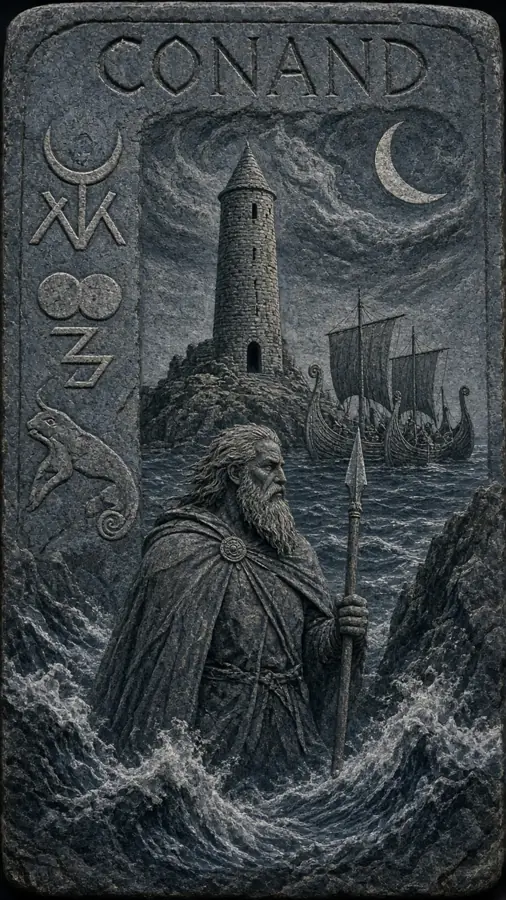
Last time: Cichol and the first battle of Ireland. Today the next age, the time of Nemed, and the Fomorian who held a tower in the western sea. Legend from Lebor Gabála Érenn (Macalister's translation, on Mary Jones's site). Not history. Told from their side.
The Name
The prose calls him "Conand s. Febar". The poems call him "Conaing son of Faebar" and "Conaing the great", "with hard body". He ruled alongside another Fomorian, "More, s. Dela".
The Tower
Lebor Gabála says the Tower of Conand is named from him, "which to-day is called Toirinis Cetne. In it was the great fleet of the Fomoraig." A poem calls it "Torinis, island of the tower, the fortress of Conaing son of Faebar". Toirinis is usually taken to be Tory Island off Donegal, the same island linked with Balor in later folklore. That link is identification, not text.
The Samhain Tax
After Nemed died of plague, his people were "under great oppression". Every Samhain, "two thirds of the progeny, the wheat, and the milk of the people of Ireland" had to be brought to Mag Cetne. A poem calls it "a lasting tax through ages of the world". From the Fomorian side, this was tribute from a people their kings had beaten. Nemed had killed two Fomorian kings, Gand and Sengand, and won three more battles against them.
The Storming
"Wrath and sadness seized on the men of Ireland." Three champions led them: Semul, Erglan and Fergus Red-Side. "Thirty thousand on sea, other thirty thousand on land, these assaulted the tower." Sixty thousand against one fortress. "Conand and his progeny fell." A poem says it was Fergus himself who killed him.
More Comes Too Late
More son of Dela came "with the crews of three-score ships" to help. The poem says: "Conaing fell previously, More thought it grave tidings." He came anyway.
The Sea Takes Both
They "fell in a mutual slaughter. The sea came up over the people of Ireland." The poem: "the sea-surge drowned them all, except thrice ten men." Of Nemed's huge host, one ship of thirty warriors got away.
Where the Survivors Went
The text sends them out across the world: Semeon to the Greeks, whose line came back later as the Fir Bolg; Fergus Red-Side's son Britan Mael to Britain; the sons of Beoan to "the north of Alba". Legend, not a record of real migrations.
A Note on Sources
Every quote here comes from CELT or Mary Jones's site, listed below. The prose and the poems spell his name two ways, Conand son of Febar and Conaing son of Faebar, so we give both as written. Reading Toirinis as Tory Island is a common identification, not something the text says. Anything else you may have heard about him is not in the Mary Jones text used here, so we leave it out.
From Their Side
The texts were written by the winners' descendants and call the tower a place of "rapine" and "the rage of the Fomoire of the sea". But even in their telling, Conand was a lord with a fortress, a fleet and an ally who sailed to save him. The taking of his tower ended in a sea that swallowed everyone. Scholars often read the Fomorians as powers of the sea. That is interpretation, not text.
These are legends from medieval manuscripts, not recorded history.
Sources
First shared on TikTok @johnshaw333.
Read in the Pictish Mystic app · Draw a free Pictish rune reading