Pictish Mystic · Lore · Picts
The Cruthin of Dál nAraidi: Ulster's “Picts”?
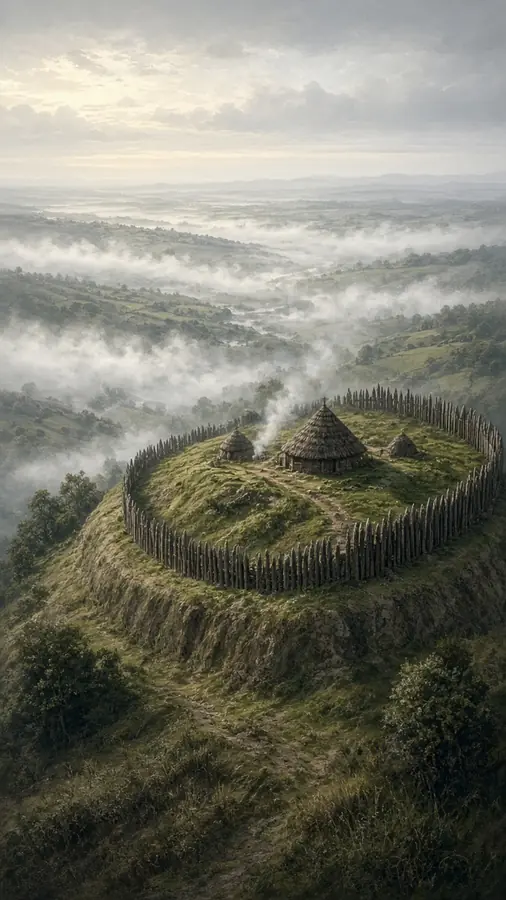
In Scottish Gaelic a Pict is a Cruithneach, and the old Gaelic name for Pictland was Cruithentúath. Yet the Irish annals also name a people called the Cruithin (Old Irish Cruithni) living in Ulster itself, from the 6th century to the 8th. Were they an Irish branch of the Picts, or something else that happened to share the name? This article, part 10 of our Picts series, keeps the record, the legends and the scholarly debate apart, because they say different things.
History (The Name)
Cruithin goes back to a Q-Celtic form usually reconstructed as *Qritani or *Quriteni. It is the counterpart of the Brittonic *Pritani, the Pretani: the name the Greek explorer Pytheas recorded for the people of the islands of Britain in the 4th century BC. Where Brittonic had p, Irish kept the older q/c sound, so Pritani and Cruithni are the same word in two branches of the language family.
So the name itself means something like “the people of Britain” in an old sense. That is why Irish writers used Cruithni for the Picts of Scotland, and why the medieval Pictish Chronicle gives the Picts an ancestor called Cruithne son of Cing. But a shared name is not, by itself, proof of a shared people.
History (What the Annals Record)
The best evidence for the Ulster Cruthin is the Annals of Ulster, with the related Chronicon Scotorum; both are online in translation at CELT, University College Cork.
- 563, Móin Daire Lothair. The battle was “won over the Cruithin by the Uí Néill of the North”. Báetán son of Cenn, with two branches of the Cruithin, fought against the other Cruithin, and Cenél nEógain and Cenél Conaill were hired, “being given the Lee and Ard Eolarg as recompense”. Chronicon Scotorum says seven kings of the Cruithin fell there, including Áed Brecc.
- 565. Áed Dub son of Suibne, a Cruthin king of Ulster, is said to have killed the high king Diarmait mac Cerbaill. Adomnán's Life of Columba, written about 700, calls Áed Dub “of Cruthin race”.
- Fíachnae mac Báetáin, of the late 6th and early 7th century, is remembered as the most powerful of the Cruthin kings.
- 629, Fid Eóin. Mael Caích son of Scannal, king of the Cruithin, was victor, and Connad Cerr, king of Dál Riata, fell. The same year, at Dún Ceithirn, Congal Cáech took flight and Domnall son of Áed was victor.
- 637, Mag Rath (Moira, Co. Down). Congal was killed by Domnall son of Áed. Historians link this battle with the defeat of Congal's ally Domnall Brecc of Dál Riata.
- 668. The battle of Fertas (Belfast) between the Ulaid and the Cruithin.
- 681. “The burning of the kings” at Dún Ceithirn, where Dúngal son of Scannal, king of the Cruithin, is named among the kings.
- 773. The last annal entry to use the name: Flathruae mac Fiachrach, rex Cruithne. After that the kingdom is called Dál nAraidi.
Dál nAraidi covered much of what is now Co. Antrim and north Co. Down. Some place-names are thought to keep the old name: Duncrun and Drumcroon in Co. Londonderry, and Ballycrune and the Crown Mound in Co. Down.
Legend (Bede and Cruithne Son of Cing)
The best-known legend is in Bede's Ecclesiastical History (I.1, written in 731). Bede says the Picts came by sea from Scythia and landed first in Ireland. The Irish would not let them settle, but sent them on to northern Britain and gave them Irish wives, on condition that when the succession was in doubt they would choose their king from the female line. Bede reports this as a story he was told.
The Pictish Chronicle and Irish learned tradition give the Picts a founding father, Cruithne son of Cing, whose seven sons divided Pictland between them. These are origin legends shaped centuries after the events they describe. They tell us how medieval writers explained the link between Irish Cruithni and Scottish Picts, not what actually happened.
Debate (Were the Cruthin Picts?)
Scholars have argued about this for more than a century, and they do not agree.
- Kenneth Jackson (1954) thought the name might point to Iron Age incomers from Britain, but he was clear that the Irish Cruithni “were not and never had been Picts”.
- No Irish source calls the Ulster Cruthin Picti. As F. J. Byrne notes in Irish Kings and High-Kings, Latin writers kept Picti for the Picts of Scotland.
- Dáibhí Ó Cróinín calls the idea that the Cruthin were “Irish Picts” closely connected with the Picts of Scotland “quite mistaken”.
- M. O. Anderson argued that the name Cruithni was given to the Scottish Picts only from about the 9th century.
- J. P. Mallory and T. E. McNeill describe the Cruthin as “archaeologically invisible”: nothing in their material culture sets them apart from their neighbours. They bore Gaelic names and, as far as we can tell, spoke Irish.
- John Koch allows that the name may preserve a genuine Iron Age link with Britain.
- Alex Woolf (2012) has suggested that Dál Riata itself may have been part of the Cruthin grouping.
- T. F. O'Rahilly's 1946 model, with the Cruthin as an early “Pretanic” population of Ireland, is no longer accepted in its original form.
The most cautious reading is that Cruithni was an old ethnic or dynastic label in Ulster, related in origin to the name of the Britons, and that by the time we can see them in the annals the Cruthin were a Gaelic-speaking people like their neighbours. Whether that label once marked a real connection with the Pretani of Britain, and so distantly with the Picts, is still an open question.
Sources
- Annals of Ulster (U563.1, U629.1–2 and later entries), CELT: https://celt.ucc.ie/published/T100001A/
- Chronicon Scotorum (CS563, CS565, CS637, CS681), CELT: https://celt.ucc.ie/published/T100016.html
- Adomnán, Life of Columba (c. 700)
- Bede, Ecclesiastical History of the English People I.1 (731)
- The Pictish Chronicle
- K. H. Jackson, “Two Early Scottish Names”, Scottish Historical Review 33 (1954)
- F. J. Byrne, Irish Kings and High-Kings (1973)
- D. Ó Cróinín, Early Medieval Ireland 400–1200 (1995)
- M. O. Anderson, “Picts: The Name and the People”, in A. Small (ed.), The Picts: A New Look at Old Problems (1987)
- J. P. Mallory and T. E. McNeill, The Archaeology of Ulster (1991)
- J. T. Koch, “New thoughts on Albion, Ierne, and the ‘Pretanic’ Isles”, Proceedings of the Harvard Celtic Colloquium (1986)
- A. Woolf, “Ancient Kindred? Dál Riata and the Cruthin” (2012)
- T. F. O'Rahilly, Early Irish History and Mythology (1946)
Written by John for pictishmystic.online.
History, legend and scholarly debate are marked separately in the headings above.
First shared on X @dalriada36963 and TikTok @johnshaw333.
Read in the Pictish Mystic app · Draw a free Pictish rune reading