Pictish Mystic · Lore · Picts
Aberlemno: The Pictish Symbol Stones Up Close
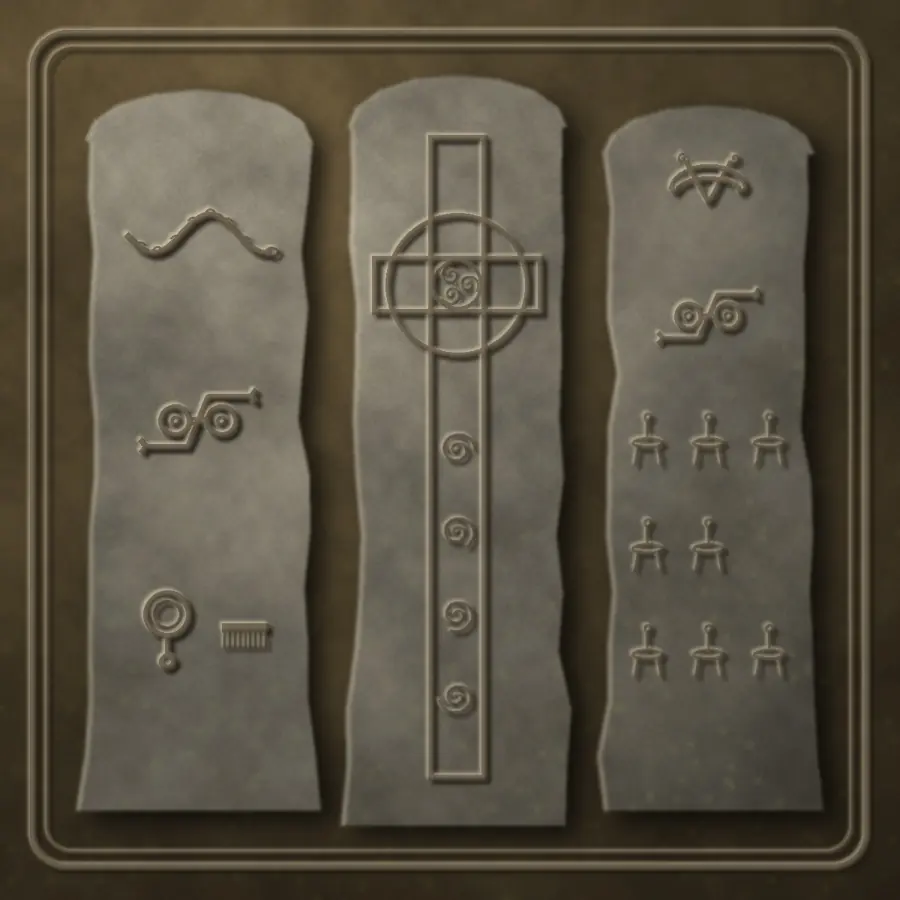
Halfway between Forfar and Brechin in Angus lies the small village of Aberlemno: a couple of farms, a school, a church, and some of the finest carved stones the Picts ever made. Three stand in a row in recesses of the dry-stone wall beside the B9134, a fourth stands in the kirkyard, another was ploughed up nearby and now sits in a museum, and in 2020 archaeologists found a new one under the floor of a medieval building. This is part 9 of our Picts series: the symbol stones up close, through the stones of one village. As always, history and archaeology, legend and scholarly debate are kept apart, and the sources are named.
History (Class I, II and III)
The Picts carved their symbols but never wrote down what they meant. The system most people still use to sort the stones is modern. In The Early Christian Monuments of Scotland (1903), J. Romilly Allen and Joseph Anderson divided them into three classes. Class I stones are unshaped or roughly shaped stones with symbols incised (cut as lines) and no cross. Class II stones are shaped slabs carved in relief, with a Christian cross on one face and Pictish symbols, usually on the other. Class III stones carry crosses and figure scenes but no Pictish symbols. The scheme is a convenience for us, not a Pictish idea, and it is not a strict timeline, but Aberlemno has fine examples of the first two classes side by side.
History (Aberlemno 1, the Serpent Stone)
The northernmost roadside stone is a Class I symbol stone of Old Red Sandstone, 1.83 m tall, 0.91 m wide and 0.23 m thick, of stone consistent with a local source in the Aberlemno to Finavon Hill area (Historic Environment Scotland, Statement of Significance). On its front, cut deep and confident, are three symbols: a serpent at the top, a double disc and Z-rod in the middle, and a mirror and comb at the bottom. On its back are cup-marks of probable prehistoric date. So this was most likely a standing stone already thousands of years old when the Picts chose it and carved it again, probably sometime between the 6th and 8th centuries AD. Robert Edward's map of 1678 may already show it among three "crosses" by the road, then drawn on the west side, though today the stones stand to the east of the road.
History (Aberlemno 2, the Kirkyard Stone)
In the churchyard stands a Class II cross-slab, about 2.3 m tall, 1.3 m wide at the base tapering to 0.9 m, and 0.2 m thick. The west face carries a cross filled with interlace and key-pattern, with a central boss of three interlinked triskeles. Around it are beasts: one biting a serpent, three identical quadrupeds in an S-curve, two insect-like creatures bound together, and two hippocamps, with the front half of a horse and the tail of a fish, touching hooves. A hole was bored through the top of the slab long after it was carved.
On the back are two symbols, a notched rectangle with Z-rod and a triple disc, and below them nine figures in three rows: five riders and four on foot. One side wears helmets with long nose-guards; the other is bare-headed with long hair. At the top a helmeted rider flees, his sword and shield dropped, chased by a bare-headed rider. In the middle three bare-headed foot soldiers with spears, a sword and shields face a helmeted rider. At the bottom two riders meet, and beside them a helmeted man lies dead while a large bird pecks at him. Read as a story, the bare-headed side wins (HES; Canmore).
History (Aberlemno 3, the Roadside Cross-Slab)
The tallest roadside stone is a Class II cross-slab 2.82 m tall, weighing about 1.8 tonnes, carved on all four sides. The front has a ringed cross with a raised central boss, interlace and key-pattern, with two angels and two beasts. Both edges are cut with running double spirals. On the back, at the top, are two large symbols: a double disc and Z-rod whose discs hold seven interwoven spirals, and a crescent and V-rod filled with key-pattern. Below is a hunt: four horsemen, two men on foot blowing trumpets behind them, one more in front, three hounds and three deer. At the bottom a centaur carries an axe over his shoulder and a tree under his arm, and beside him a man splits the jaws of a lion, most likely the biblical David, with a harp and a sheep above, the shepherd and the minstrel (HES, citing Allen & Anderson 1903). Its nearest artistic relative is the Hilton of Cadboll stone from Easter Ross, which has a closely similar hunting scene.
History (The Fall of 2025)
Every year, from the last working day of September to the first working day of April, Historic Environment Scotland covers the Aberlemno stones with wooden boxes to protect them from frost. As you read this in late October, they are boxed for the winter. In March 2025 Aberlemno 3 and its box were blown over in exceptionally strong winds and fell against the dyke behind. HES moved the stone to its conservation centre in Edinburgh. There conservators found carving that had been hidden for centuries under the collar stone, the socket that held the slab; its sharpness suggests it had been exposed for only 100 to 150 years of the stone's 1,200. A triangular piece had broken off along a crack already known from earlier 3D scanning, and traces of water inside the cracks suggest years of seepage had weakened the base (HES; The Courier, September 2025). In 2026 HES and AOC Archaeology excavated the collar stone and the buried part of the slab at the roadside. HES says the results will take time, but one question it hopes to answer is whether Aberlemno 3 has stood in the same place since it was raised, or was moved to stand beside the others.
History (The Other Aberlemno Stones)
- Aberlemno 4, the Flemington Farm stone, was found in the early 1960s about 30 yards from the church (Boyd and Henderson, 1962). It is a Class I stone about 1.5 m tall with a horseshoe and a Pictish Beast, the beast's head damaged by ploughing. It is now in The McManus in Dundee.
- Aberlemno 5, the middle roadside stone, has only faint marks and may be unfinished or a later fake.
- The Woodwrae stone came from a ruined castle about a kilometre north of the village, where it had been used as a floor slab. In 1819 it was taken to Sir Walter Scott's collection at Abbotsford; it was given to the Society of Antiquaries of Scotland in 1924 and is now in the National Museum of Scotland.
- The newest stone: in early 2020 a University of Aberdeen team led by Gordon Noble, working on the Leverhulme-funded Comparative Kingship project, ran geophysical surveys at Aberlemno, dug one small test pit to check what looked like a settlement, and came straight down on a carved symbol stone, one of only around 200 known. The find was announced in March 2022. The grey sandstone stone is 1.73 m long and carries triple ovals, a mirror and comb, a crescent and V-rod and double discs, and unusually some symbols overlie others, so it was carved at different times. It had been laid as paving in a large building of the 11th or 12th century, alongside a cup-marked stone, and beneath that building were layers of settlement going back to the Pictish period. Noble called it "an exceptional find for our knowledge of the Picts" and said Aberlemno was likely "an important centre in the Pictish period". The stone now stands at the entrance to Aberlemno Village Hall.
History (The Name)
The village name begins with aber, a word for a river mouth or confluence that belongs to the Brittonic speech of the Picts and survives in Welsh. Simon Taylor (2011) lists aber among the Pictish place-name elements of eastern Scotland, as in Aberdeen. It is one of the ways the old Brittonic tongue of the Pretani, the name the earliest Greek accounts gave the peoples of Britain (often explained as "the people of the designs"), still sits on the map.
Legend (The Danes at Aberlemno)
The earliest written notice of the kirkyard stone comes from Hector Boece in his Scotorum Historia (1527). He wrote that a noble company of Danes was cut down by the Scots near Aberlemno, four miles from Brechin, and that "here a great stone was erected, carved with lifelike figures" to record the victory for posterity. Boece tied this to a Battle of Barry against the Danes that is now known to be unhistorical, but his reading of the stone held well into the 19th century, appearing in the Statistical Accounts and in Andrew Jervise's notes of 1856.
Debate (Which Battle, If Any?)
In 1985, 1300 years after the battle of Dún Nechtáin (Nechtansmere), Graeme Cruickshank argued that the kirkyard scene shows that very battle: the Pictish king Bridei son of Beli's victory over Ecgfrith of Northumbria on 20 May 685, fought, it was then believed, at Dunnichen, a few miles south of Aberlemno. The helmets, with their long nose-guards, look like the Anglian Coppergate helmet found at York in 1982, and some have even read the dead man under the bird as Ecgfrith himself. The idea won wide acceptance.
But there are doubts. Back in 1955 Robert Stevenson of the Museum of Antiquities had judged the helmets a general sub-Roman type and the helmeted men likely to be Picts too. Anna Ritchie (1991), reviewing Cruickshank's case, urged caution. Then Alex Woolf (2006) argued that Dún Nechtáin was more likely Dunachton in Badenoch, some 80 km away across the Cairngorms. And art historians (Trench-Jellicoe 1999; Laing 2000 and 2001) now date the stone to the mid-9th century, about 150 years after the battle. Other readings have been offered: a battle between Picts and Vikings, a memorial to the 8th-century Pictish king Óengus son of Fergus (Cummins 1999), or a spiritual struggle rather than a real fight. Historic Environment Scotland's own wording is careful: the scene "may" commemorate Nechtansmere.
Debate (Dates and Places)
Aberlemno 3 has been dated to the late 8th century, but more recent comparisons suggest the first half or middle of the 9th century (HES Statement of Significance; Trench-Jellicoe 1999). Whether the roadside stones stand where they were first raised is also open: the 1678 map shows them on the other side of the road, and the 2026 excavation may settle it for Aberlemno 3.
Debate (What Do the Symbols Mean?)
No one knows. Suggestions over the years have included names or titles of people, kin-groups, marriages, or memorials to the dead, but no reading has been proved. Aberlemno also shows the limits of the neat class scheme. The new stone found in 2020 has symbols carved at different times, one over another, and the Serpent Stone reuses a prehistoric monument, so these were stones with long lives, carved, recarved, moved, reused as paving and floor slabs, and still being uncovered today.
Sources
- J. Romilly Allen and J. Anderson, The Early Christian Monuments of Scotland (1903), Part III
- Historic Environment Scotland, Statements of Significance for Aberlemno I and Aberlemno III, and the churchyard cross-slab; Aberlemno Sculptured Stones, History and stories; Scheduled Monument SM90004
- Canmore, Archaeology InSites: Aberlemno Pictish Cross Slab
- Hector Boece, Scotorum Historia (1527)
- A. Jervise, PSAS 2 (1856)
- R.B.K. Stevenson, "Pictish Art", in F.T. Wainwright (ed.), The Problem of the Picts (1955)
- J.D. Boyd, Discovery and Excavation in Scotland (1962); I. Henderson, "Two Pictish Symbol Stones", PSAS 95 (1962)
- G. Cruickshank, Nechtansmere 1300 (1985); A. Ritchie, review (1991)
- R. Trench-Jellicoe, PSAS 129 (1999); W.A. Cummins, The Picts and their Symbols (1999)
- L. Laing, Medieval Archaeology 44 (2000); PSAS 131 (2001)
- A. Woolf, "Dun Nechtain, Fortriu and the Geography of the Picts", Scottish Historical Review 85 (2006)
- I. Fraser, The Pictish Symbol Stones of Scotland (RCAHMS, 2008)
- S. Taylor, "Pictish place-names revisited", in Pictish Progress (2011)
- University of Aberdeen news, 7 March 2022; The Scotsman
- The Courier (2025 and 2026) and HES updates on the conservation of Aberlemno III
History, legend and scholarly debate are marked separately in the headings above.
First shared on X @dalriada36963.
Read in the Pictish Mystic app · Draw a free Pictish rune reading