Pictish Mystic · Lore · Picts
Bridei son of Beli and the Battle of Dún Nechtáin, 20 May 685
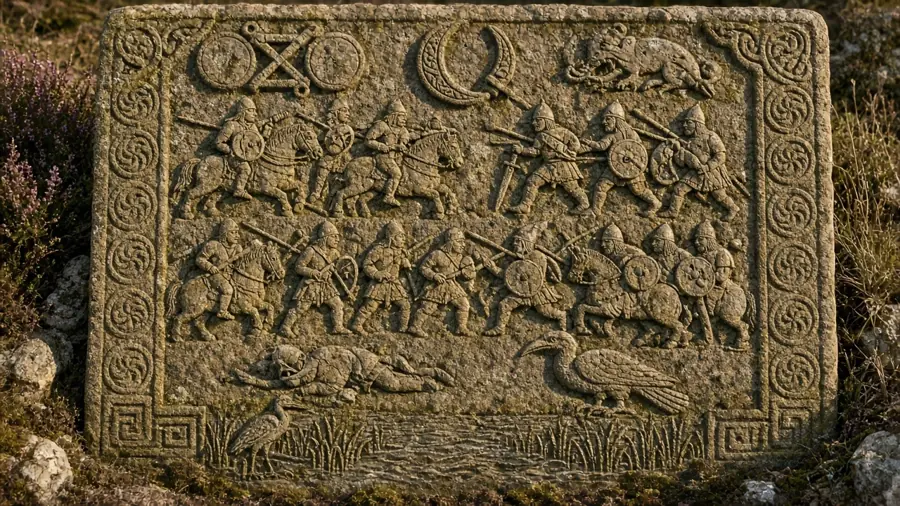
On a Saturday in May 685, somewhere in Pictland, the Pictish king Bridei son of Beli destroyed the army of Ecgfrith of Northumbria and killed the king himself. It was one of the turning points of early Scottish history. This article, part 2 of our Picts series, follows the battle through the real sources: Irish annals, Bede, the Lives of St Cuthbert, a Welsh history, Irish poems and a carved stone in Angus. History, legend and scholarly debate are marked separately.
History (Who Was Bridei?)
The Irish annals call him Bruide mac Bili, and the Annals of Tigernach give him a title: rex Fortrenn, king of Fortriu, the most powerful of the Pictish kingdoms. The Irish Life of Adomnán calls him rí Cruithneach, king of the Cruithni. Cruithni is the Gaelic form of the old Pretani name, the same word the Irish used for the Cruthin of Ulster.
His father was not a Pict. A verse attributed to Adomnán, abbot of Iona, calls Bridei mac rígh Ala Cluaithe, son of the king of Ail Cluaithe, the British fortress-kingdom on Dumbarton Rock on the Clyde, also called Alt Clut. His father Beli is listed in the Welsh genealogies as a king of that line. The Welsh Historia Brittonum, compiled in the early ninth century, goes further and calls Bridei the fratruelis, the cousin, of his enemy Ecgfrith. The two kings who met in 685 were kinsmen.
If the Belin whose death the Welsh Annales Cambriae record in 627 was his father, Bridei must have been well over fifty by 685. Ecgfrith, Bede tells us, was in the fortieth year of his age.
History (Northumbria in the North)
For a generation before 685, Northumbria had been the dominant power in northern Britain. Stephen of Ripon's Life of Wilfrid describes a Pictish rising early in Ecgfrith's reign, crushed so completely that two rivers were said to be filled with corpses. Bede records that in 681 Archbishop Theodore made Trumwine bishop "in the province of the Picts, which at that time was subject to the English". Trumwine's seat was the monastery of Abercorn, on the south shore of the Firth of Forth.
In 684 Ecgfrith sent his general Berht to raid Ireland. Bede says he "miserably laid waste that unoffending nation, which had always been most friendly to the English", sparing neither churches nor monasteries. The Annals of Ulster record it in their own words: "The Saxons lay waste Mag Breg, and many churches, in the month of June." Bede adds that Ecgfrith had ignored the holy man Egbert, who begged him not to attack the Irish.
History (Bridei's Campaigns, 680 to 683)
While Northumbria looked south and west, the Annals of Ulster record a run of attacks on strongholds across the north. None of the entries names the attacker, but most historians see Bridei's hand in them:
- 680: the siege of Dún Baite, probably Dunbeath in Caithness.
- 681: the siege of Dún Foither, Dunnottar on the Kincardineshire coast.
- 682: "The Orkneys were destroyed by Bruide" (Orcades deletae sunt la Bruide), the one entry that names him.
- 683: the siege of Dún At and the siege of Dún Duirn, Dunadd in Argyll and Dundurn in Strathearn.
In the same annal year as Orkney, the Annals of Ulster also record the battle of Ráith Mór in Mag Line (in today's Co. Antrim), where Cathasach son of Mael Dúin, king of the Cruithin, fell fighting against Britons. The Irish chroniclers followed the Picts and the Cruthin of Ulster side by side.
History (The Battle, Saturday 20 May 685)
Bede, writing at Jarrow in 731, gives the fullest account (Ecclesiastical History IV.26). Ecgfrith "rashly led his army to ravage the province of the Picts, greatly against the advice of his friends, and particularly of Cuthbert, of blessed memory, who had been lately ordained bishop". The Picts "made a feigned retreat, and the king was drawn into a narrow pass among remote mountains, and slain, with the greater part of the forces he had led thither, on the 20th of May".
The Irish annals supply the name and the day. The Annals of Ulster: "The battle of Dún Nechtain was fought on Saturday, May 20th, and Egfrid son of Oswy, king of the Saxons, who had completed the 15th year of his reign, was slain therein with a great body of his soldiers." The Annals of Tigernach repeat the entry and add the victor: Ecgfrith was killed "by Bruide son of Bile, king of Fortriu". The Latin says sabbati die, Saturday. The Annals of Inisfallen remember it simply as "a great battle between the Picts".
The Welsh Historia Brittonum has its own name. Ecgfrith "made war against his cousin Brudei, king of the Picts, and he fell therein with all the strength of his army, and the Picts with their king gained the victory; and the Saxons never again reduced the Picts so as to exact tribute from them. Since the time of this war it is called Gueith Lin Garan." Gueith means battle and lin a lake or pool, and garan is the crane or heron: the battle of the crane lake. A later Northumbrian chronicle, the Historia Regum attributed to Symeon of Durham, calls the place Nechtanesmere, "the lake of Nechtan", and adds a remarkable detail: Ecgfrith's body was buried on Iona, the island of Columba.
History (After the Battle)
Bede, who was a boy of about twelve at Jarrow when the news came south, wrote: "From that time the hopes and strength of the Anglian kingdom began to ebb and fall away; for the Picts recovered their own lands, which had been held by the English, and so did also the Scots that were in Britain; and some of the Britons regained their liberty." Of the English in Pictland, some fell by the sword, some were enslaved and some escaped. Bishop Trumwine left Abercorn with his monks and spent the rest of his life at Whitby (Streanaeshalch), where Ecgfrith's sister Ælfflæd and her mother Eanflæd ruled the monastery.
Ecgfrith's half-brother Aldfrith, a scholar who had studied among the Irish, became king and, in Bede's words, "nobly retrieved the ruined state of the kingdom, though within narrower bounds". The Annals of Tigernach record that soon afterwards Adomnán of Iona "brought 60 captives to Ireland", Irish people taken in the raid on Brega.
Bridei himself died a few years later. The Annals of Ulster and Tigernach both record: "Bruide son of Bile, king of Fortriu, dies", in the annal for 692 or 693, depending on how the years are reckoned. The Annals of Inisfallen call him king of the Picts.
Legend (Cuthbert at Carlisle)
The Lives of St Cuthbert are saints' Lives, written to show holiness, not battle reports. They are early, though. The Anonymous Life, written at Lindisfarne around 700, says that while Ecgfrith was laying waste the kingdom of the Picts, Cuthbert came to Carlisle (Luel), where the queen was awaiting news of the war. On the Saturday, at three in the afternoon, the reeve of the city, Waga, was showing him the city wall and a fountain "formerly constructed by the Romans". Cuthbert suddenly leaned on his staff, bowed his face to the ground, then lifted his eyes to heaven and groaned: "I fear the war is over, and that judgment has been pronounced." Within a few days, the Life says, word came that the battle had been fought and ended on that very day and at that very hour.
Bede's own prose Life of Cuthbert (chapter 27) tells the same story. The year before, Cuthbert had told Ecgfrith's sister that the king would live only one more year. At Carlisle he murmured "Now, then, the contest is decided!", and when a priest asked how he knew, he answered, "Do you not see how wonderfully the air is changed and disturbed?" He told the queen to set out early on Monday for the royal city, "lest, perchance, the king may have been slain".
Legend (A Poem from Bangor)
An Old Irish poem, Iniu feras Bruide cath (Today Bridei gives battle), is attributed to Riagail of Bangor, the great monastery of Bennchor on the shore of Belfast Lough in Co. Down. In a translation used by the historian Tim Clarkson, it begins:
Today Bridei gives battle over the land of his grandfather, unless it is the wish of the Son of God that restitution be made.
Today the son of Oswiu is slain in battle against iron swords. Even though he did penance, it was penance too late.
Like Bede, the poet saw Ecgfrith's death as payment for the raid on Brega. The phrase im forba a senathar, "for his grandfather's inheritance", has made historians ask which grandfather, and what land, Bridei was fighting for. For Ulster it is a reminder that the monks of Co. Down watched events across the North Channel closely, and that this story belongs to everyone on both shores.
Legend (Bridei on Iona)
Betha Adamnáin, the tenth-century Irish Life of Adomnán, tells that the body of "Bruide son of Bile, king of the Cruithni" was carried to Iona, and that Adomnán grieved for him. He asked for the body to be brought into a house overnight and kept watch over it until morning. At dawn the body began to move and its eyes to open. A devout monk at the door objected: if Adomnán began raising the dead, no abbot after him would be accepted unless he could do the same. Adomnán agreed there was right in that, blessed the body and Bridei's soul, and Bridei gave up his spirit to heaven again. Then Adomnán spoke the verse:
Great the wonders done by the King who was born of Mary ... death to Bruide son of Bile. It is a rare thing, after ruling a kingdom, that a hollow block of withered oak should be about the son of the king of Ail Cluaithe.
The resurrection scene is legend. The verse may be older than the Life, and the oak coffin fits real archaeology: log burials are increasingly recognised in early medieval Scotland, with many at Whithorn and Thornybank and examples at the royal site of Forteviot.
Debate (Where Was Dún Nechtáin?)
No source tells us exactly where the battle was fought. In the early nineteenth century the antiquarian George Chalmers identified Dún Nechtáin with Dunnichen in Angus, whose name appears in medieval charters in forms of Dun Nechtan, and he pointed to Dunnichen Moss, a drained marsh, as the lake. Dunnichen became the textbook site, and the battle is still often called the battle of Dunnichen.
In 2006 Alex Woolf challenged this in his article Dun Nechtain, Fortriu and the Geography of the Picts (Scottish Historical Review 85). He argued that Fortriu lay north of the Mounth on the Moray Firth, not in Strathearn and Menteith as nineteenth-century scholars thought, and that the battle may have been fought in Badenoch, at Dunachton (Gaelic Dùn Neachdain, Nechtan's fort) on the north-west shore of Loch Insh. Mid-Angus has no "remote mountains"; Badenoch does. Dunachton even has its own Pictish symbol stone, carved with a stylised deer's head and found in 1870 reused as a door lintel.
Not everyone is convinced. James Fraser, in From Caledonia to Pictland (2009), judged that Dunnichen cannot yet be ruled out but needs more special pleading than Dunachton. Tim Clarkson still favours Dunnichen. Others point out that Bede may not have known Pictish geography well. Both places carry the same name, Nechtan's fort, and the question is still open.
Debate (Does Aberlemno Show the Battle?)
In the churchyard at Aberlemno, a few miles from Dunnichen, stands one of the finest Pictish cross-slabs, known as Aberlemno II. It is Old Red Sandstone, 2.28 metres tall. The front bears a great ring-headed cross. The back carries two Pictish symbols, a notched rectangle with Z-rod and a triple disc, and below them a battle: nine figures in three rows, five mounted and four on foot. One side is bareheaded. The other wears helmets with long nose-guards, which have been compared to the Anglian Coppergate helmet from York. A helmeted rider flees, dropping sword and shield. Three bareheaded foot soldiers face a horseman. At the bottom a helmeted warrior lies dead while a large bird pecks at him.
In 1985, the 1300th anniversary of the battle, the historian Graeme Cruickshank argued that this is Dún Nechtáin, carved to remember the Pictish victory. The idea was widely taken up, and many have wondered whether the fallen helmeted warrior is meant to be Ecgfrith himself. The critiques:
- Date: Historic Environment Scotland places the stone probably in the late eighth century, and some art historians argue for the mid-ninth, generations after 685. Cruickshank was criticised for suggesting it was made soon after the battle.
- Place: if Woolf is right about Dunachton, Aberlemno's nearness to Dunnichen proves nothing. Historic Environment Scotland now calls the link a once "seductive idea" that is "now unlikely".
- Helmets: as early as 1955 Robert Stevenson suggested the helmets were of a general sub-Roman type, so the helmeted men need not be Northumbrians.
- Other readings: a battle between Picts and Vikings, a memorial to the eighth-century king Óengus son of Fergus, or a spiritual struggle.
Even so, the stone remains one of very few Pictish carvings of warfare, and the best picture we have of how Pictish warriors fought on foot and on horseback. It is covered by a wooden box from the end of September to the start of April to protect it from frost.
Debate (Why It Mattered)
Historians often see Bridei's reign as the start of the Verturian hegemony, when the kings of Fortriu became overkings of the Picts. Writers including James Fraser in The Pictish Conquest and From Caledonia to Pictland argue that 685 ended Northumbrian rule north of the Forth for good and helped turn many Pictish peoples into one kingdom, the kingdom that would later become Alba. Fraser's 2006 book is subtitled The Battle of Dunnichen 685 and the Birth of Scotland, but how far one battle made a nation is part of the debate.
Sources
Primary sources:
- Annals of Ulster, entries for 680 to 693 (CELT edition, University College Cork).
- Annals of Tigernach, entries for the 680s and 690s (CELT edition).
- Annals of Inisfallen (CELT edition).
- Bede, Ecclesiastical History of the English People, IV.12 and IV.26.
- Anonymous Life of St Cuthbert, written at Lindisfarne about 700 (translated by W. Forbes-Leith; edited by Bertram Colgrave in Two Lives of Saint Cuthbert, 1940).
- Bede, Prose Life of St Cuthbert, chapters 24 and 27.
- Historia Brittonum, chapter 57.
- Historia Regum, attributed to Symeon of Durham.
- Stephen of Ripon, Life of Wilfrid.
- Betha Adamnáin, the Irish Life of Adomnán (edited by Máire Herbert and Pádraig Ó Riain, Irish Texts Society 54).
- Iniu feras Bruide cath, poem attributed to Riagail of Bangor.
Modern scholarship:
- Alex Woolf, Dun Nechtain, Fortriu and the Geography of the Picts, Scottish Historical Review 85 (2006), 182 to 201.
- James E. Fraser, The Battle of Dunnichen 685 (2002), reissued as The Pictish Conquest: The Battle of Dunnichen 685 and the Birth of Scotland (2006).
- James E. Fraser, From Caledonia to Pictland: Scotland to 795 (Edinburgh University Press, 2009).
- Graeme Cruickshank, The Battle of Dunnichen (1985 and 1991), and his essay The Battle of Dunnichen and the Aberlemno Battle-Scene, in the collection Alba, edited by E. J. Cowan and R. A. McDonald (2000).
- Historic Environment Scotland, Statement of Significance: Aberlemno Churchyard Cross Slab, and scheduled monument record SM937 (Dunachton symbol stone).
- Campbell, Driscoll, Gondek and Maldonado, The Strathearn Environs and Royal Forteviot project (2019), on log burials.
- Tim Clarkson, Against iron swords: Dun Nechtáin, AD 685 (Senchus blog, 2013).
History, legend and scholarly debate are marked separately in the headings above.
First shared on X @dalriada36963.
Read in the Pictish Mystic app · Draw a free Pictish rune reading