Pictish Mystic · Lore · Picts
Who Were the Picts? From the Pretani to the Cruthin
The Picts are among the most talked-about and least understood peoples of early Britain. They left no histories of their own that survive, only carved stones, a handful of king-lists and the words other people wrote about them. This overview walks through what the sources actually say, marking clearly what is history, what is legend, and where scholars still disagree.
History: the Pretanic Isles
Around 325 BC the Greek explorer Pytheas of Massalia sailed the northern seas. His own book is lost, but later writers such as Strabo and Diodorus quote him, and through them we get the earliest name for these islands: the Pretanic Isles, home of the Pretani or Priteni. Most scholars see this name behind Welsh Prydain (Britain) and behind the Irish word Cruithin, the Gaelic form of the same name.
History: the Roman view
Tacitus' Agricola (written AD 98) describes his father-in-law's campaigns in the far north, ending with the battle of Mons Graupius in AD 83 or 84 against the Caledonians. Tacitus gives their leader Calgacus a famous speech: 'they make a desert and call it peace'. Around AD 150 Ptolemy's Geography mapped northern Britain and listed its peoples, including the Caledonii, Vacomagi, Taexali and Venicones.
The word Picti, 'the painted (or tattooed) ones', first appears in a Latin panegyric of AD 297, traditionally linked to the orator Eumenius, which names the Picts alongside the Irish (Hiberni) as enemies of Roman Britain. Writing in the later 4th century, Ammianus Marcellinus says the Picts were divided into two peoples, the Dicalydones and the Verturiones, and describes the 'barbarian conspiracy' of 367 when Picts, Scots, Attacotti and Saxons struck Roman Britain together.
History: kings, saints and battles
Adomnán's Life of Columba (around 700) records the saint's visit to the Pictish king Bridei son of Maelchon near the River Ness in the 560s, and notes that Columba needed an interpreter, a sign that the Picts spoke a different language from Irish Gaelic. Bede, finishing his Ecclesiastical History in 731, says Columba converted the northern Picts and that the southern Picts had earlier been taught by Ninian.
The Irish annals, especially the Annals of Ulster and the Annals of Tigernach, record Pictish kings, deaths and battles year by year. The best known is the battle of Dún Nechtáin (Nechtansmere) in 685, where the Pictish king Bridei son of Beli defeated and killed Ecgfrith of Northumbria, ending Northumbrian power north of the Forth. By the late 9th century the Pictish kingdom had become the Gaelic kingdom of Alba, traditionally linked to Cináed mac Ailpín (Kenneth MacAlpin), and the name Pictavia fades from the record.
History: the symbol stones
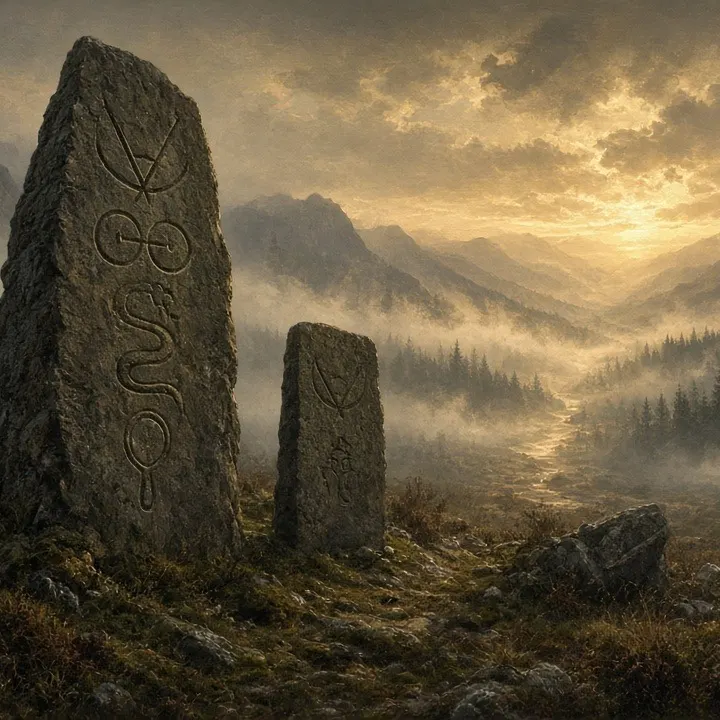
The Picts' own voice survives in stone. Across eastern and northern Scotland stand carved stones bearing a shared set of symbols: the crescent and V-rod, the double disc and Z-rod, the 'Pictish beast', the mirror and comb, salmon, eagles and more. Since Allen and Anderson's survey of 1903 they have usually been grouped as Class I (incised symbols on undressed stones), Class II (relief cross-slabs with symbols) and Class III (Christian sculpture without symbols). Aberlemno in Angus is one of the best places to see them, including a slab often read as a battle scene.
Legend: Cruithne and his seven sons
Bede tells an origin legend: the Picts came from Scythia, landed first in Ireland, and were told by the Scots to settle in Britain instead, taking Irish wives on condition that, when in doubt, kingship would pass through the female line. Lebor Bretnach, the 11th-century Irish version of the Historia Brittonum, adds Pictish king-lists and the story of Cruithne, father of the Picts, whose seven sons Fib, Fidach, Fotla, Fortrenn, Cait, Ce and Circinn gave their names to seven provinces. These are later learned traditions, not eyewitness history, though some names, such as Fife (Fib), Atholl (Ath Fotla) and Caithness (Cait), still echo on the map.
The Cruthin of Ulster
The Irish annals use the same word, Cruithni, for both the Picts of Scotland and a people in Ulster. The Ulster Cruthin are linked above all with Dál nAraidi, a kingdom in what is now Antrim and Down, whose kings appear in the annals; the best known is Congal Cáech, who fell at the battle of Mag Rath in 637. For anyone in Ulster today this is shared heritage, belonging to everyone who lives on this land, whatever their background.
Debate: Picts and Cruthin, one people or two?
Because the names match, some earlier writers, notably T. F. O'Rahilly, treated the Cruthin as Irish Picts. Many later historians are more cautious: the shared name goes back to the old Pretani name for the peoples of Britain, and there is no clear evidence in language, archaeology or law that the Ulster Cruthin were Picts in the Scottish sense. The link is real in the name; whether it was real in the people is still argued.
Debate: language, matrilineal kingship and the north
- Language: Katherine Forsyth's work argues that Pictish was a Brittonic Celtic language, close to early Welsh, rather than the mysterious non-Celtic tongue once proposed.
- Matrilineal succession: Bede's story has long been read as proof of female-line kingship. Alex Woolf and others have questioned how far it reflects real practice.
- Fortriu: Woolf's 2006 'Verturian hypothesis' moved the heartland of Fortriu, the leading Pictish kingdom, from Strathearn north to Moray and the Moray Firth, a view now widely accepted.
- Genetics: a 2023 ancient-DNA study (Morez and colleagues, PLOS Genetics) found that people from Pictish-period burials were broadly local, part of a long continuity with earlier Iron Age Britain rather than incomers from far away.
History: new digs, new picture
Since 2015 the University of Aberdeen's Comparative Kingship project, led by Gordon Noble, has excavated major Pictish power centres such as Rhynie, Burghead and the hillfort of Tap o' Noth, showing large, organised royal sites with links across Europe. James Fraser's From Caledonia to Pictland (2009), Alex Woolf's From Pictland to Alba (2007) and Gordon Noble and Nicholas Evans' The King in the North (2019) are good next steps for anyone who wants to go deeper.
Sources and further reading
- Pytheas of Massalia, via Strabo, Geography, and Diodorus Siculus, Library of History
- Tacitus, Agricola (AD 98)
- Ptolemy, Geography (c. AD 150)
- Latin Panegyric of AD 297 (attributed to Eumenius)
- Ammianus Marcellinus, Res Gestae, book 27 (late 4th century)
- Adomnán, Life of Columba (c. 700)
- Bede, Ecclesiastical History of the English People (731), book 1 ch. 1 and book 3 ch. 4
- Annals of Ulster; Annals of Tigernach
- Lebor Bretnach (Irish Historia Brittonum, 11th century)
- J. Romilly Allen and Joseph Anderson, The Early Christian Monuments of Scotland (1903)
- T. F. O'Rahilly, Early Irish History and Mythology (1946)
- Katherine Forsyth, Language in Pictland (1997)
- Alex Woolf, 'Dún Nechtáin, Fortriu and the Geography of the Picts', Scottish Historical Review (2006); From Pictland to Alba (2007)
- James E. Fraser, From Caledonia to Pictland: Scotland to 795 (2009)
- Gordon Noble and Nicholas Evans, The King in the North: The Pictish Realms of Fortriu and Ce (2019)
- Morez et al., 'Imputed genomes and haplotype-based analyses of the Picts of early medieval Scotland', PLOS Genetics (2023)
- University of Aberdeen, Comparative Kingship project (Northern Picts)
History, legend and scholarly debate are marked separately in the headings above.
Read in the Pictish Mystic app · Draw a free Pictish rune reading