Pictish Mystic · Lore · Picts
Ogham in Pictland: The Mystery of the Pictish Language
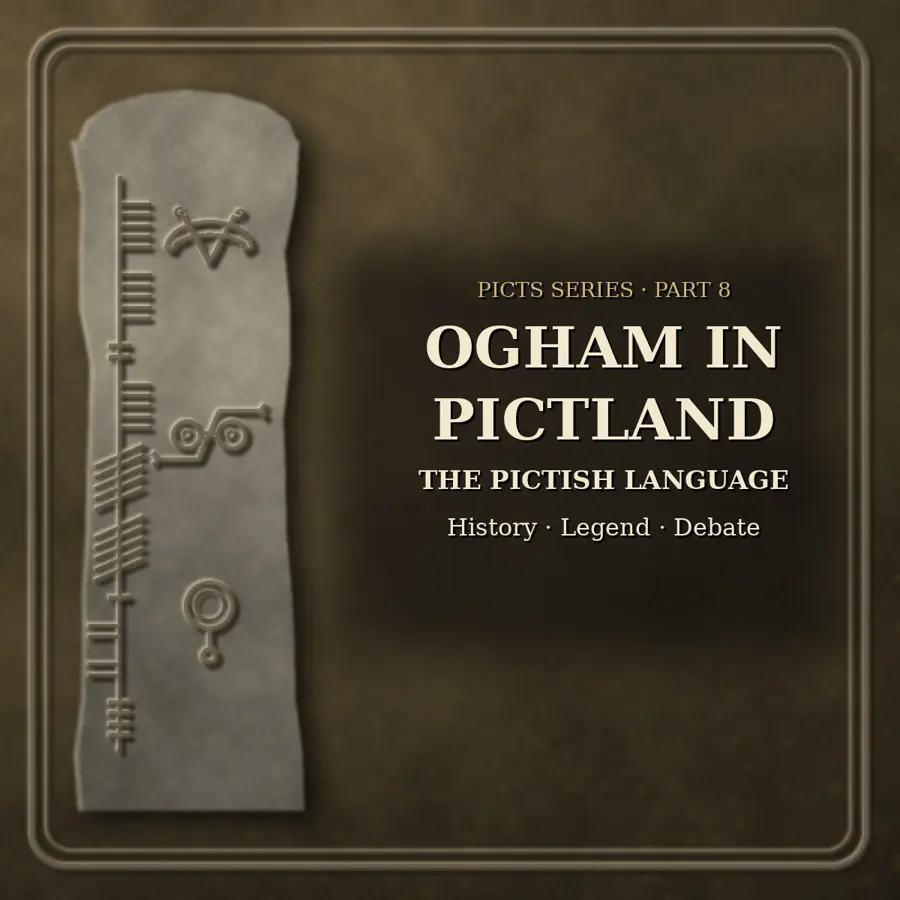
The Picts left us hundreds of carved stones, but almost no words. Their own books, if they had any, are lost. What survives is a scatter of names in chronicles and king-lists, a layer of place-names under the map of eastern and northern Scotland, and some forty short inscriptions cut in ogham, the stroke-alphabet invented in Ireland. Some of those inscriptions can be read. Others have defeated every scholar who has tried for more than 150 years. This is part 8 of our Picts series, on ogham in Pictland and the long debate over what language the Picts spoke. As always, history and archaeology, legend and scholarly debate are kept apart, and the sources are named.
History (What Ogham Is)
Ogham is an alphabet of strokes and notches cut along a line. In the classic Irish stones the line is the natural edge of a standing stone, and the letters are groups of one to five strokes on either side of it or across it, with vowels as notches. It was devised in Ireland, probably in the early centuries AD, to write the Irish language, and from Ireland it spread to Wales, the Isle of Man and Scotland.
In Pictland ogham took on its own character. The BabelStone survey of Scotland's ogham counts about 34 inscriptions on stone and five more on portable objects, and most of them lie in what was Pictish territory: the east coast north of the Forth, Aberdeenshire above all, and Orkney and Shetland. Katherine Forsyth, who edited the whole Scottish corpus in her 1996 Harvard doctoral thesis, showed that most Pictish ogham is cut not along a natural edge but along a carved line on the face of the stone, often on symbol stones and cross-slabs where the ogham is part of the design. Pictish ogham also uses letters that are rare elsewhere, and a letter written H, often doubled as HH, turns up again and again, above all before T in forms of the name Nechtan. Doubled and tripled letters are everywhere. Most are thought to be later than the classic Irish stones, many of them from the 8th to the 10th centuries.
History (Stones That Speak)
- Brodie, Moray: a cross-slab from the churchyard of Dyke, now at Brodie Castle, with fish-monsters, a Pictish beast, and the double disc and Z-rod. It carries three ogham inscriptions on its edge mouldings. Forsyth reads one as EDDARRNONN, the Pictish name Etharnon or Ethernan (Canmore 15529).
- Scoonie, Fife: a cross-slab with a hunting scene of horsemen, hounds and a stag, now in the National Museum of Scotland (X.IB 110). Its ogham also reads EDDARRNONN.
- Lunnasting, Shetland: found in April 1876, five feet down in a peat bog, and now in the National Museum of Scotland (IB 113). Forsyth reads ETTECUHETTS : AHEHHTTANNN : HCCVVEVV : NEHHTONS. The last word is a form of Nechtan. The rest is still argued over.
- Bressay, Shetland: a cross-slab of the 9th or early 10th century with a lion and a horseman among its carvings (NMS IB 109). It reads CRROSCC : NAHHTVVDDADDS : DATTRR : ANN, and on the other edge BENNISES MEQQ DDROANN. CRROSCC looks like the Gaelic word for a cross, MEQQ means "son of", and DATTRR may be the Norse word for daughter. Forsyth saw in it a Christian family where Norse and Gaelic speakers had married.
- Buckquoy, Birsay, Orkney: a little spindle whorl dug up in 1970 in a settlement of the 7th to early 9th century. Forsyth (PSAS 125, 1995) read it as Old Irish, BENDDACT ANIM L, "a blessing on the soul of L".
- Golspie, Sutherland: a cross-slab now in the Dunrobin Castle museum. Its ogham, ALLHHALLORREDD MAQQ NIA ..., has been read as "the monument of Alored, son of the nephew of ...".
- Formaston, Aboyne, Aberdeenshire: a granite cross-slab fragment found under a church doorstep before 1874. Its ogham names Nehht and Talorg, both Pictish names, and seems to mention Kineff; Forsyth has suggested it records a grant of land.
These are the inscriptions that can be partly understood, and they tell us something important: a good number of them are in Gaelic, or a mixture, with Pictish personal names inside them. Others cannot be read at all.
History (The Newton Stone)
The strangest Pictish inscription of all stands in the grounds of Newton House near Insch in Aberdeenshire. It was found in 1804 on a hillside about three-quarters of a mile away. It is a granite pillar with an ogham inscription down its edge and, on its face, six rows of letters in an alphabetic script that no one has ever convincingly read. A small mirror symbol is carved low on the pillar, and beside it on the same estate stands a second stone, a Pictish symbol stone with a notched double disc and a serpent and Z-rod.
In 2021 Kelly Kilpatrick published a full study in the Proceedings of the Society of Antiquaries of Scotland (volume 150). She showed that the ogham should be read from the top down, giving IDDARRNNN, the same name Etharnon found at Brodie and Scoonie. She argued that the mysterious script is related to the informal Latin-letter script that Late Antique writers scratched with a stylus, that it was probably painted on before it was carved, that the inscription is in the Pictish language, and that the stone probably dates to the 6th or early 7th century. That would make it one of the earliest pieces of writing in Pictland.
History (What the Old Writers Said)
Bede, writing in Northumbria in 731, says at the opening of his Ecclesiastical History (I.1) that Britain studies one and the same knowledge of the highest truth in five languages, matching the five books of the divine law: English, British, Irish, Pictish and Latin. For Bede, Pictish was a language of its own. In I.12 he gives one of the very few Pictish words anyone recorded: the place at the eastern end of the Antonine Wall was called "Peanfahel" in Pictish, Penneltun in English. Today it is Kinneil.
Adomnán, abbot of Iona, wrote his Life of Columba around 700. Twice he says Columba, an Irish speaker, needed an interpreter. On Skye an aged pagan, Artbranán, "chief of the war-band of Geon", heard the word of God "per interpretem", through an interpreter, and was baptised (I.33). In the province of the Picts a whole family heard Columba preach "per interpretatorem" and were baptised (II.32).
The names of Pictish kings survive in the king-lists, and many have a Brittonic shape. The great king Unuist son of Uurguist, who died in 761, appears in Irish annals as Óengus son of Fergus, and Uuen son of Unuist, killed in 839, as Eóganán. The Irish annals also record, about 669, that "Itarnan and Corindu died amongst the Picts", the same name Etharnon carved on the Brodie, Scoonie and Newton stones.
History (Words in the Land)
The Pictish language also survives in place-names. Simon Taylor ("Pictish place-names revisited", in Pictish Progress, 2011) sorted these elements by how Pictish they are. Some are Brittonic words never borrowed into Gaelic, such as aber "river mouth" (Aberdeen, Abernethy), pert "wood or thicket" (Perth) and lanerc "clearing". Others, like carden "enclosure" (Kincardine), were borrowed into Gaelic only in names. Others still, like pett "a piece of land, a farm", became ordinary Gaelic words. That is why so many Pit- names, such as Pitlochry, pair a Pictish word with a Gaelic one, a sign of Pictish and Gaelic speakers living side by side on the same land.
Legend and Tradition (Scythia and the Seven Sons)
Bede tells the Picts' origin story as he heard it: they came from Scythia in long ships, were turned away from Ireland, and were told by the Irish to settle in the north of Britain. Having no women, they asked the Irish for wives, which were given on condition that, when the matter was in doubt, they would choose their kings from the female line rather than the male. Bede says this custom was kept among the Picts in his own day. This is an origin legend, not a record of events, and its meaning for real Pictish succession is still argued over.
Irish tradition, in the Lebor Bretnach (the Irish version of the Historia Brittonum) and the Pictish king-list, tells of Cruithne, son of Cinge, father of the Picts, and his seven sons, Fib, Fidach, Fotla, Fortrenn, Cait, Ce and Circinn, who divided the land between them. Several of their names echo the Pictish lands: Fife, Atholl, Fortriu, Caithness. In this telling the people are named from the land and the land from the people, which is how the old stories remember them.
Legend and Tradition (The Newton Stone Decipherers)
The Newton Stone grew its own modern legend. In the 19th century it was "read" as Phoenician, Greek, Hebrew, Aramaic and more. Whitley Stokes remarked in 1892 that it had been read into "Punic, Syriac, Greek, Latin, French, Icelandic, and various kinds of gibberish". In 1935 R.A.S. Macalister compared would-be decipherers to the Baker in Lewis Carroll's Hunting of the Snark, who would "softly and suddenly vanish away". None of these readings is accepted by scholars today.
Scholarly Debate (Not Aryan?)
In 1892 John Rhys published "The Inscriptions and Language of the Northern Picts" (PSAS 26). He decided the Pictish ogham inscriptions were in a language that was, "so far as I can judge, not Aryan", that is, not Indo-European at all, and he challenged anyone who thought them Brittonic to explain Lunnasting as Welsh, or he would have to "confess that I have never rightly understood a single word of my mother tongue".
In 1955 Kenneth Jackson's chapter "The Pictish Language", in F.T. Wainwright's The Problem of the Picts, set the terms for half a century. Jackson saw two languages: a Brittonic dialect, which he called "Pritenic", known from the names of people and places, and an older, unknown, non-Indo-European language spoken by an earlier population, which he thought was the language of the unreadable ogham. He firmly rejected any link with Basque.
Scholarly Debate (Forsyth and the Case Against)
Katherine Forsyth turned this around. In "Language in Pictland: the case against 'non-Indo-European Pictish'" (1997) she argued that ogham is merely a script, invented for Irish and awkward for other languages; that the odd look of the Pictish inscriptions reflects their later date and the manuscript tradition rather than a lost language; and that "on current evidence the non-Indo-European verdict is premature". She proposed Brittonic readings for some texts: ETTECUHETTS at Lunnasting and EHTECONMORS at Cunningsburgh in Shetland as "this is as far" and "this is as great", perhaps boundary markers. John Koch added that no convincing non-Indo-European etymology has ever been found for a single Pictish word or name. Guto Rhys's 2015 Glasgow thesis, "Approaching the Pictish language", re-examined the early evidence and the idea of "Pritenic", and today most scholars see Pictish as a Brittonic language, a close relative of early Welsh.
Scholarly Debate (Norse or Unknown?)
In 1999 Richard Cox argued in The Language of the Ogam Inscriptions of Scotland that 19 inscriptions, among them the Buckquoy whorl, were Old Norse of 1050 to 1350. Michael Barnes, a runic specialist, rejected this in Northern Studies (1999): the conclusion was assumed from the start, the readings needed many emendations, and the dates clash with the archaeology. Thomas Clancy and Cathair Ó Dochartaigh were equally critical.
The most recent full test came from Simon Rodway, "The Ogham Inscriptions of Scotland and Brittonic Pictish" (Journal of Celtic Linguistics 21, 2020). He re-examined the inscriptions Forsyth thought most promising for Brittonic, including Burrian in Orkney, Brandsbutt in Aberdeenshire, Cunningsburgh and Lunnasting, and found that each proposed reading depends on "the long arm of coincidence". His conclusion is an open verdict: "the language of this corpus of inscriptions remains unknown". It is not proof of a lost non-Indo-European tongue, only an honest admission that we cannot yet read these stones.
So the picture today is this. Pictish names and place-names show a Brittonic language. Some ogham in Pictland is plainly Gaelic, some mixed with Norse. And a stubborn core of inscriptions, Lunnasting among them, still keeps its secret.
Sources
- Bede, Ecclesiastical History of the English People I.1 and I.12 (731)
- Adomnán, Life of Columba I.33 and II.32 (c. 700)
- J. Rhys, "The Inscriptions and Language of the Northern Picts", PSAS 26 (1892), 263–351
- K.H. Jackson, "The Pictish Language", in F.T. Wainwright (ed.), The Problem of the Picts (1955)
- K. Forsyth, "Language in Pictland: the case against 'non-Indo-European Pictish'" (Utrecht, 1997); The Ogham Inscriptions of Scotland: an edited corpus (Harvard PhD, 1996); Buckquoy, PSAS 125 (1995)
- R.A.V. Cox, The Language of the Ogam Inscriptions of Scotland (1999); M.P. Barnes, review, Northern Studies 34 (1999)
- S. Taylor, "Pictish place-names revisited", in Pictish Progress (Brill, 2011)
- G. Rhys, Approaching the Pictish Language (PhD, Glasgow, 2015)
- S. Rodway, "The Ogham Inscriptions of Scotland and Brittonic Pictish", Journal of Celtic Linguistics 21 (2020)
- K. Kilpatrick, "The Newton Stones and writing in Pictland", PSAS 150 (2021)
- Ogham in 3D (DIAS), BabelStone's survey of Scotland's ogham stones, Canmore and National Museums Scotland records
History, legend and scholarly debate are marked separately in the headings above.
First shared on X @dalriada36963.
Read in the Pictish Mystic app · Draw a free Pictish rune reading