Pictish Mystic · Lore · Fomorians
Balor of the Evil Eye – Their Side of the Story
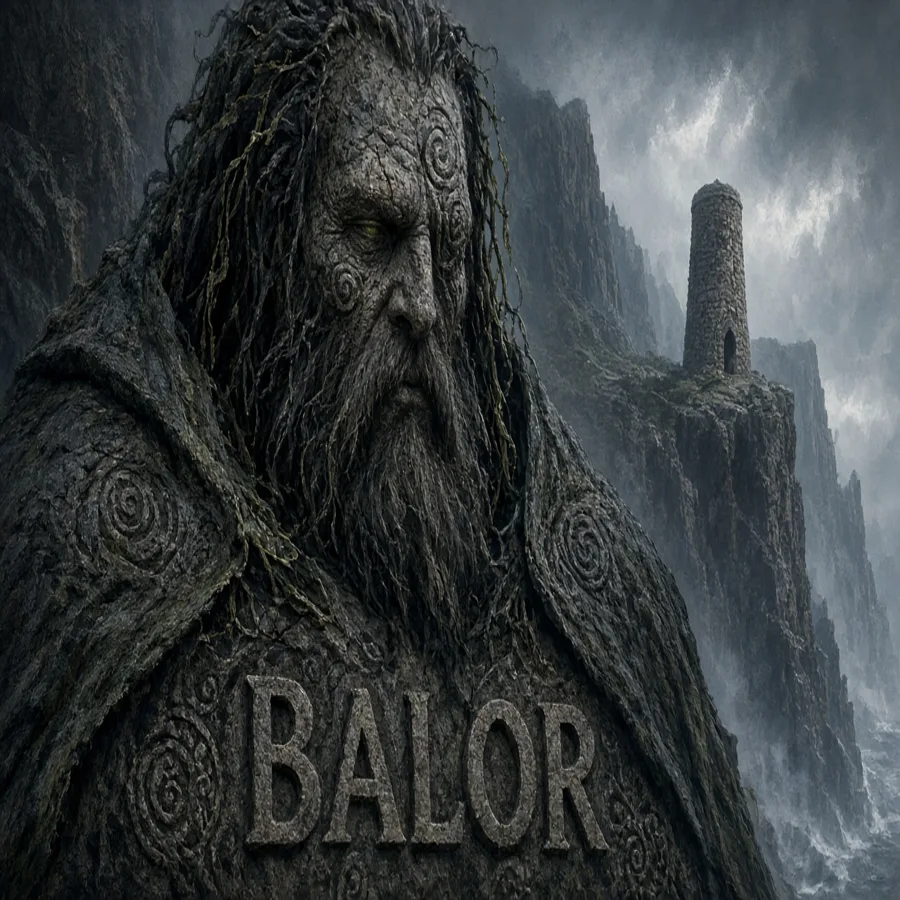
Today their most famous face. Legend from manuscripts and folklore — not history. The monks wrote the winners' version. Here is Balor's side.
The Name
Balor / Balar. Early epithets: Béimnech "the Smiter"; Balcbéimnech "the Strong Smiter"; Birugderc "of the Piercing Eye". Later: Balór na Súile Nimhe, "of the Evil Eye". Root debated: Common Celtic *Boleros "the flashing one" (Ó hÓgáin, O'Rahilly) — not settled. In Donegal an evil eye is still súil Bhalloir — Balor's eye.
Who He Was (legend)
Cath Maige Tuired (Second Battle of Mag Tuired): Balor ua Néit, grandson of Nét; also mac Doit meic Néid — son of Dot son of Nét. Champion of the Fomoire and "king of the Hebrides". A Book of Leinster builders' list names his father Buarainech ("cow-faced"). Later tradition (O'Flaherty's Ogygia) gives him wife Cethlenn of the Crooked Teeth. Lebor Gabála names Cethlenn wounding the Dagda with a javelin at Mag Tuired (fatal 120 years on) but does not itself call her Balor's wife. Their daughter Ethne (Ethniu) and Cían son of Dían Cécht had Lugh — so Ireland's shining hero is Balor's grandson. Kin, not strangers.
The Prophecy (folklore — not the battle-text)
Cath Maige Tuired has no tower story: there Balor gives Ethne to Cían in alliance, and she bears Lugh. The prophecy lives in Tory folklore. John O'Donovan recorded it in 1835 from Shane O'Dugan (Annals of the Four Masters, 1856): a druid warned Balor he would die by his grandchild's hand, so he locked Ethnea on Tór Mór with twelve matrons. From his side: a king trying to outrun fate.
The Cow (O'Donovan / Tory)
Balor wanted the magic cow Glas Gaivlen. He tricked her keeper at Gavida the smith's forge, appearing as a red-headed boy, and rowed her to Tory — still Port-na-Glaise, cow harbour. MacKineely's fairy Biróg stormed him into Ethnea's tower. Three sons; Balor ordered them drowned; Biróg saved one. That boy grew at the forge. Balor killed MacKineely at Clagh-a'-neely; later boasted of it to the apprentice — his own grandson — who drove red-hot iron through the deadly eye.
The Eye
Cath Maige Tuired: a destructive eye opened only in battle. Four men raised the lid by a polished ring. Hosts that looked offered no resistance. How: his father's druids were brewing magic; the boy looked over the window; fumes settled venom in the eye. Folklore shifts the picture — a rear killing eye, or a forehead eye under leather coverings. A Mayo telling peels seven coverings one by one until the land blazes. Same fear: a gaze that ends harvest. From his side: a weapon made by accident, then used to hold power.
How He Fell (Cath Maige Tuired)
Balor killed Núadu Silverhand and Macha. Then he met Lugh. "Lift up my eyelid, lad," he said, "so I may see the talkative fellow who is conversing with me." The lid rose. Lugh's sling-stone drove the eye through his head onto his own host. He fell, crushing twenty-seven; his crown struck Indech so blood spouted over the king's lips. A later tradition: Lugh beheaded him at Mizen Head — Carn Uí Néit, cairn of Nét's grandson.
Scholars (interpretation)
Some read the scorching sun — drought that Lughnasa overcomes (Ó hÓgáin, MacNeill). Krappe: old year against new. Others: older sea and chaos powers order must face but never erase. Parallels: Welsh Ysbaddaden, the Cyclops, Acrisius and Perseus. Sea-raiders from the northern isles? Manuscripts will not say. They do say: grandfather to Lugh, Hebrides king in the tale, the eye the winners feared.
Still On The Map
Tory: Dún Bhalair, Túr Bhalair, Tór Mór, Port na Glaise. The stones outlast the monks' verdict.
These are legends from medieval manuscripts, not recorded history.
First shared on TikTok @johnshaw333.
Read in the Pictish Mystic app · Draw a free Pictish rune reading