Pictish Mystic · Lore · Fomorians
The Fomorians – Ireland’s Oldest Powers, Their Side of the Story
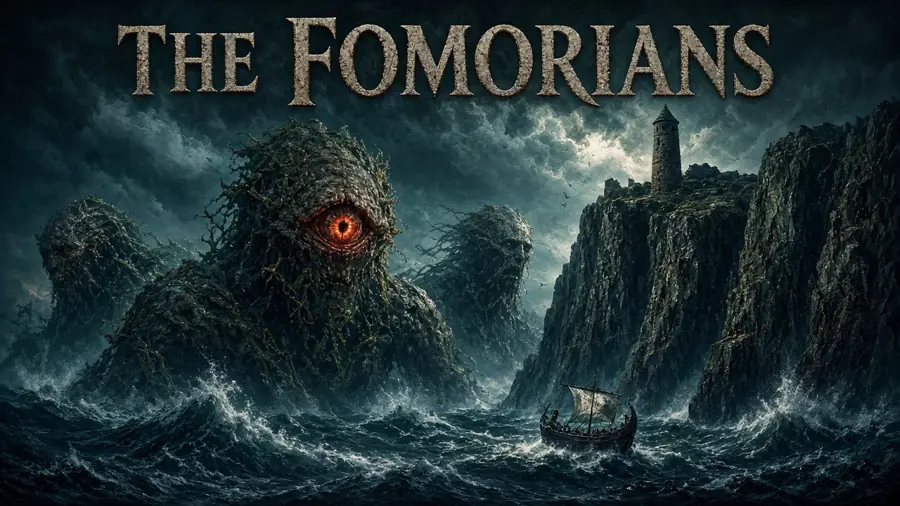
Every Irish myth is told by the winners. These are legends from medieval manuscripts, not recorded history, and the monks who wrote them had their own agenda.
The Name
Fomoire. Old reading: fo "under" + muir "sea", the people from under/beyond the sea. Modern scholars mostly prefer fo + mor, a word for phantom or demon (the same root as the -mare in nightmare, maybe the Mór- in Morrígan). Sea-raiders or underworld spirits? The debate is still open.
Where They Came From (legend)
Lebor Gabála Érenn, the "Book of Invasions", makes them descendants of Ham (son of Noah), some versions Cain: a Christian way to label them cursed. Some are described with one arm, one leg, one eye. Yet they're there from the start: their leader Cichol Gricenchos fought Partholon, the first settler after the Flood, at Mag Itha. In other words, they were here first.
Conand's Tower
Nemed's people were ruled from Conand's Tower on Tory Island, Donegal. Every Samhain they paid two-thirds of their corn, their milk and their children. Nemed's sons stormed the tower and took it, but More son of Dela's fleet came, the sea rose, and nearly everyone drowned.
Family, Not Just Foes
The Fomorian prince Elatha came over the sea on a silver ship and met Ériu of the Tuatha Dé. Their son was Bres, "the beautiful". Later Cian of the Tuatha Dé and Ethniu, Balor's daughter, had Lugh. The two peoples were kin.
Bres's Reign (Cath Maige Tuired)
When Nuada lost his hand, the Tuatha Dé chose half-Fomorian Bres as king. His failing was meanness: no greased knives, no ale-breath at his feasts. The Dagda built forts, Ogma hauled firewood. The poet Coirpre, given a dry, cold room and three dry cakes, made Ireland's first satire: "Without food quickly on a dish... let that be Bres's prosperity." Bres broke out in red blotches, and a blemished king had to go. From his side: he was pushed out and went to his father's people for help.
The Second Battle of Moytura
Bres, Indech and Balor gathered from the Hebrides to Norway, which tells you the writers saw them as northern sea-power. In battle, Octriallach son of Indech found the healing well where dead Tuatha Dé were revived and buried it under stones. Lugh's sling took Balor's eye. Lesser-known: Bres was spared after he gave up the secret of farming: plough, sow and reap on a Tuesday. Even in defeat, they held the knowledge of the land. And the sword of their king Tethra, found by Ogma, spoke aloud, telling of its deeds.
What Scholars Say (interpretation)
Many see them as older native powers: sea, blight, storm, darkness, the wild forces that the Tuatha Dé's order of kingship and craft must tame but can never be rid of. Alwyn and Brinley Rees read it as chaos vs cosmos. They are ancestors as much as enemies.
Folklore Still Alive
On Tory Island and in Donegal, Balor's tales were recorded in the 1830s by John O'Donovan: Balor stealing the magic cow Glas Gaibhleann, and the smith Gavida. Tory's cliffs still carry his name.
These are legends from medieval manuscripts, not recorded history.
First shared on TikTok @johnshaw333.
Read in the Pictish Mystic app · Draw a free Pictish rune reading