Pictish Mystic · Lore · Tuatha Dé Danann
Crédne, Brazier of the Tuatha Dé Danann
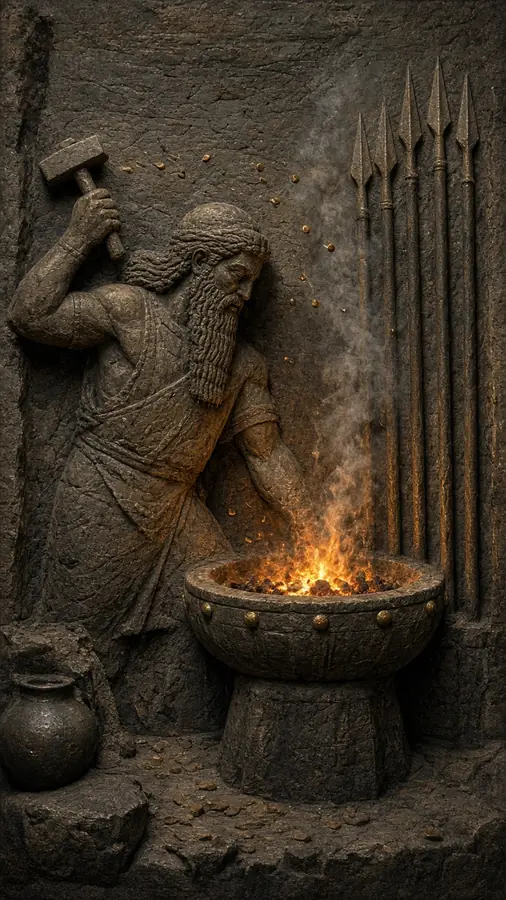
He made the rivets in three strokes, and no one had to drill a hole. Crédne was the brazier of the Tuatha Dé Danann.
How He Appears
The old texts never describe his face. In Cath Maige Tuired he is “Crédne the brazier” and “Crédne Cerd”, Crédne the craftsman. In Lebor Gabála Érenn he is “the free wright Creidne” and “Creidne the pleasant artificer”, listed with “Goibniu the smith, Luicne the carpenter, Creidne the wright, Dian Cecht the leech”. The texts show him only at his work.
The Silver Hand
In the first battle of Mag Tuired, Sreng mac Sengainn cut off the hand of Núadu. “So with Crédne the brazier helping him, Dian Cécht the physician put on him a silver hand that moved as well as any other hand.” Lebor Gabála calls it “a silver arm with activity in every finger and every joint”.
The Door of Tara
When Lug came to Tara offering his arts one by one, he said, “Question me: I am a good brazier.” The answer came back: “We do not need you. We have a brazier already, Crédne Cerd.”
His Promise
Before the Second Battle of Mag Tuired, Lug asked each of the skilled ones what power they would bring. “'And you, Crédne,' Lug said to his brazier, 'what is your power in the battle?' 'Not hard to answer,' said Crédne. 'I will supply them all with rivets for their spears and hilts for their swords and bosses and rims for their shields.'”
The Three Strokes
In the battle, Goibniu made the spearheads and Luchta the carpenter made the shafts, and “then Crédne the brazier would make the rivets with three strokes, and he would throw the sockets of the spears at them, and it was not necessary to drill holes for them; and they stayed together this way.”
His End
A poem in Lebor Gabála tells how the craftsmen of the Tuatha Dé died: “Creidne the pleasant artificer was drowned on the lake-sea, the sinister pool, fetching treasures of noble gold to Ireland from Spain.”
What He Represents
Metalwork and the joining craft. Goibniu forges the blade and Luchta shapes the shaft, but Crédne's rivets, hilts, bosses and rims hold everything together. His greatest work was not a weapon at all: it was a hand for a king.
Sources
- Cath Maige Tuired, The Second Battle of Mag Tuired, translated by Elizabeth A. Gray, CELT: https://celt.ucc.ie/published/T300010.html
- Lebor Gabála Érenn, Part 4 (§§58, 62, 64), Macalister's translation, on Mary Jones's Celtic Literature Collective: https://www.maryjones.us/ctexts/lebor4.html
Story told by John.
These are legends from medieval manuscripts, not recorded history.
First shared on X @dalriada36963 and TikTok @johnshaw333.
Read in the Pictish Mystic app · Draw a free Pictish rune reading